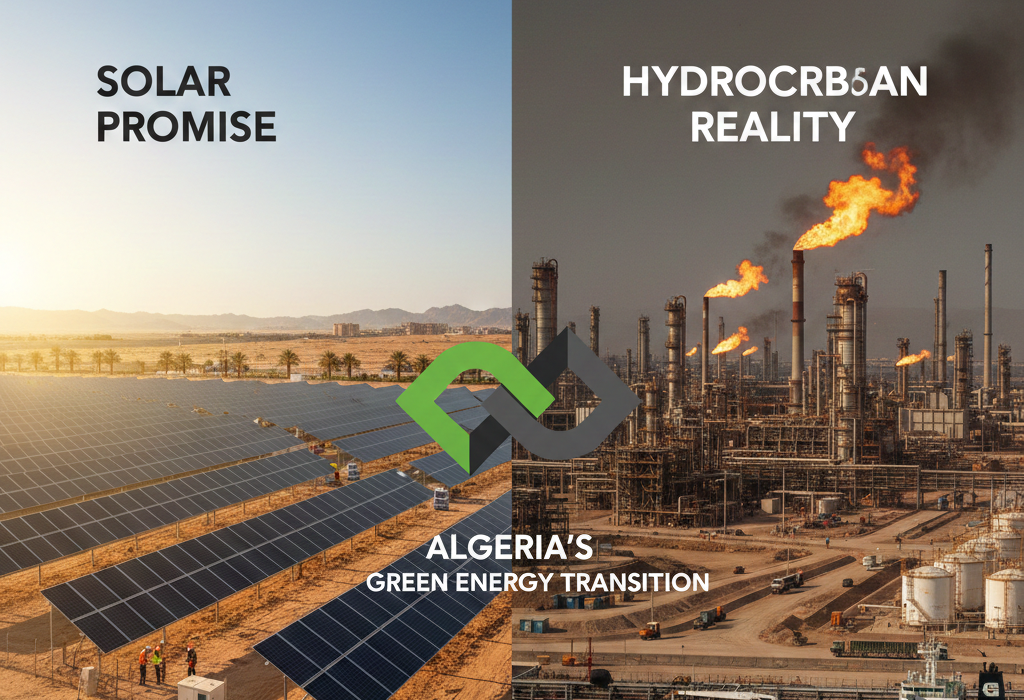

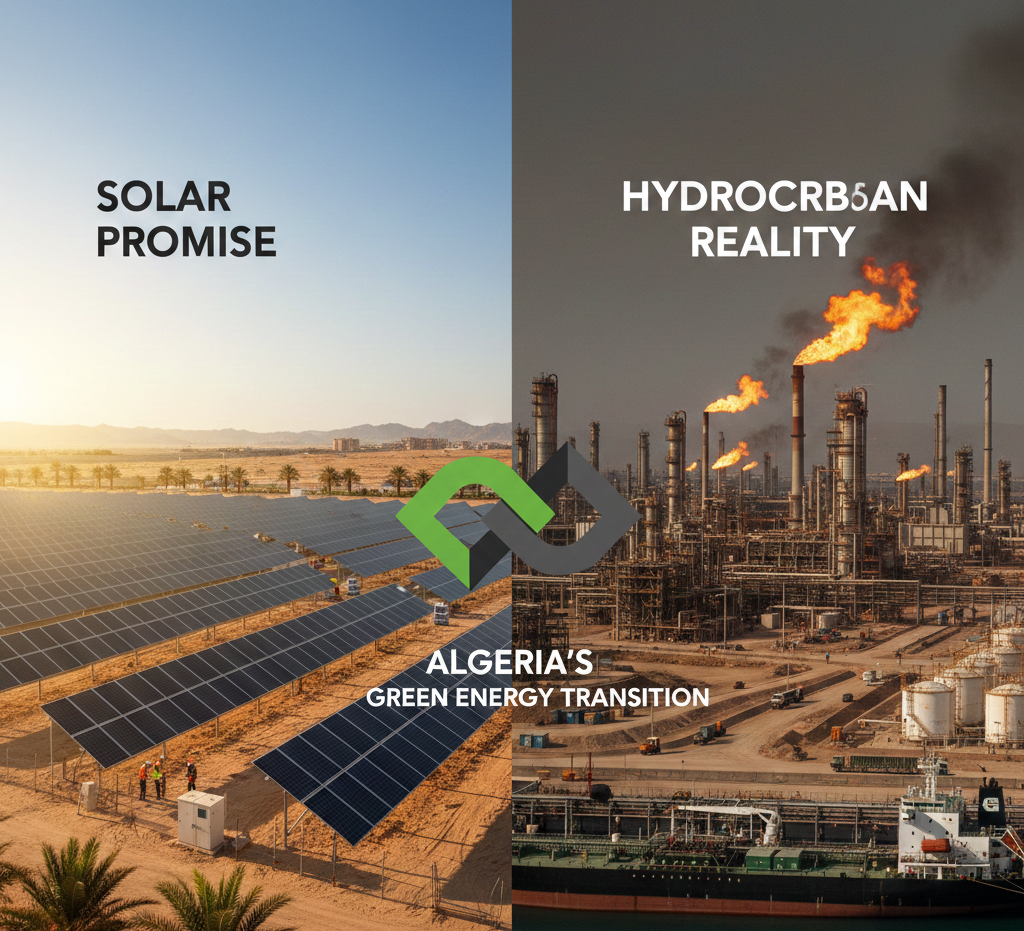
As of February 2026, Algeria finds itself at a defining moment in its modern history. Long the primary guarantor of European energy security and a stalwart of the global hydrocarbon market, the nation is now aggressively re-engineering its economic DNA. The challenge is immense: Algeria must manage its status as Africa’s leading natural gas producer while simultaneously positioning itself as a global hub for green hydrogen and solar energy.
The Hydrocarbon Foundation: Re-investment or Transition?
Algeria’s economy remains deeply anchored in fossil fuels. Natural gas and oil contribute nearly 95% of export earnings, and state-owned Sonatrach continues to be the country’s primary economic engine. In 2024 and 2025, the war in Ukraine and subsequent global energy shifts funneled record revenues into Algerian coffers.
However, this “hydrocarbon windfall” has been met with a strategic realization. Internal electricity demand is climbing at a rate of roughly 3.5% annually, largely driven by a growing population and increased cooling needs due to rising temperatures. To maintain its lucrative export capacity, Algeria must find a way to meet domestic demand without burning the very gas it sells abroad.
Economic Insight: Algeria’s 2025-2030 energy strategy allocates over $50 billion for upstream investment. The goal is clear: maximize current gas output to finance the infrastructure of a post-oil future.
Solar Energy: From Potential to Megawatts
The Algerian Sahara offers some of the highest solar irradiance levels on Earth, exceeding 2,200 kWh/m²/year. While previous years saw ambitious targets move slowly, 2026 has marked a shift toward rapid commissioning.
- Decentralization: New projects in provinces like Laghouat and El Meghaier are not only feeding the national grid but also powering remote desalination plants, addressing the country’s parallel water crisis.
- Commissioning Milestone: As of February 2026, the Ministry of Energy is on track to commission nearly 1.5 GW of solar capacity by the summer.
- Revised Targets: The National Renewable Energy Program has streamlined its focus, aiming for 15,000 MW of renewable capacity by 2035.
The Green Hydrogen Frontier and the SoutH2 Corridor
Perhaps the most ambitious pillar of Algeria’s transition is its bid to become Europe’s primary supplier of Green Hydrogen. By utilizing its extensive existing pipeline network, Algeria aims to supply 10% of Europe’s hydrogen demand by 2040.
A central piece of this puzzle is the SoutH2 Corridor, a 3,300-kilometer pipeline project connecting North Africa to Italy, Austria, and Germany.
- Political Backing: In January 2025, a landmark ministerial agreement between Algeria, Tunisia, and EU partners finalized the political framework for this corridor.
- Infrastructure Repurposing: Roughly 70% of the corridor will use repurposed natural gas pipelines, drastically reducing capital costs and environmental impact.
- Industrial Partnerships: Memorandums of Understanding (MoUs) with firms like VNG (Germany) and Snam (Italy) are already moving into pre-feasibility stages for large-scale electrolysis plants in the Algerian south.
Structural Challenges: The “Rentier” Dilemma
Despite technical progress, the “Hydrocarbon Reality” presents significant social and structural hurdles:
- Subsidies: Energy products remain heavily subsidized to maintain social stability. These low prices often mask the true cost of fossil fuel reliance and can discourage private investment in energy efficiency.
- Grid Modernization: Algeria’s grid was built for centralized gas-fired power. Integrating intermittent solar energy from the deep south requires a massive overhaul of transmission infrastructure—a project currently estimated to need over 10,000 kilometers of new high-voltage lines.
- Regulatory Evolution: The repeal of the 51/49 foreign-ownership rule in recent years has attracted capital, but bureaucratic hurdles and Dinar convertibility risks remain key concerns for international investors.
| Metric | 2024 (Actual) | 2026 (Projected/Current) | 2035 (Target) |
| Solar Capacity | ~600 MW | ~2.2 GW | 15,000 MW |
| Gas Share in Power | ~98% | ~94% | ~70% |
| Green H2 Export | 0 Tons | Pilot Phase | 1,000,000+ Tons |
Conclusion: A Strategic Re-Tooling for the 21st Century
In summary, Algeria’s green energy transition is not a simple abandonment of its hydrocarbon heritage but a sophisticated, multi-layered evolution of its identity as a global energy provider. By early 2026, the nation has moved beyond theoretical ambition, as evidenced by the 2026 Finance Bill which elevated the energy transition to a central economic pillar. This legislative shift provides the concrete tax and customs incentives necessary to reduce the high entry costs for renewable technologies, signaling to the world that Algeria is ready to use its current fossil-fuel wealth to bankroll its sustainable future.
The strategic importance of this shift is underscored by the high-level political dialogues held in Algiers in February 2026, where the European Union and Algeria reaffirmed their partnership. This relationship is evolving from a traditional buyer-seller dynamic for natural gas into a strategic alliance for clean energy. The advancement of the SoutH2 Corridor is a prime example of this synergy, as it seeks to repurpose existing gas infrastructure to transport green hydrogen, potentially meeting 10% of Europe’s demand by 2040 and ensuring that Algeria remains an indispensable energy artery in a decarbonized global economy.
Furthermore, the transition is serving as a catalyst for deep-seated structural and social change within the country. By diversifying the energy mix, Algeria is addressing the “energy trilemma” of balancing rising domestic demand, preserving lucrative export volumes, and meeting climate commitments. The development of utility-scale solar projects in the Sahara—such as the 22 sites commissioned for the 2026 rollout—does more than just generate clean electricity; it fosters local industrial ecosystems, creates high-value jobs in engineering, and supports critical climate adaptation measures like solar-powered water desalination.
However, the “hydrocarbon reality” remains a formidable presence that requires careful management. Fossil fuels continue to fund 90% of export income, and the immediate financial windfall from the recent gas boom provides a temptation to delay difficult reforms. The true success of the Algerian model lies in its ability to resist this inertia. By integrating solar power directly into oil and gas operations—a priority highlighted by Sonatrach’s new leadership in 2026—the country is lowering the carbon footprint of its traditional exports while simultaneously building the expertise needed for a fully renewable era.
Ultimately, Algeria’s path reflects a pragmatic “middle way” for resource-rich nations. It demonstrates that the transition is not a zero-sum game between economic stability and environmental responsibility. Instead, it is a strategic re-tooling that leverages the country’s unique geography and established infrastructure to bridge the gap between two eras. As the Saharan sun begins to power more of the national grid, Algeria is effectively transforming from a 20th-century oil giant into a 21st-century energy innovator, proving that its most enduring resource was never just what lay beneath the sand, but the immense energy shining above it.
As Algeria continues to harmonize its regulatory frameworks with international standards, the next few years will be critical in determining the speed of this evolution. Would you like me to look into the specific technical requirements for the SoutH2 Corridor’s pipeline repurposing, or perhaps explore the impact of the 2026 Finance Bill on local solar start-ups?