Burkina Faso in 2026: War, Realignment, and the Struggle for Stability

In early 2026, Burkina Faso stands at one of the most consequential moments in its post-independence history. The country is simultaneously prosecuting an intense counterinsurgency campaign, redefining its geopolitical alliances, restructuring its political system, and attempting to sustain economic momentum amid a deepening humanitarian emergency.
What emerges is a portrait of a state attempting to rebuild authority while under extraordinary pressure—military, diplomatic, and social. The choices made during this transitional period are likely to shape not only Burkina Faso’s future, but also the broader balance of power across the Sahel.
1. The War Effort and the Doctrine of “Total Re-conquest”
Security remains the central organizing principle of national policy. Since seizing power in 2022, Captain Ibrahim Traoré has framed the conflict as an existential struggle for sovereignty, territorial integrity, and state survival.
A Shift Toward Offensive Operations
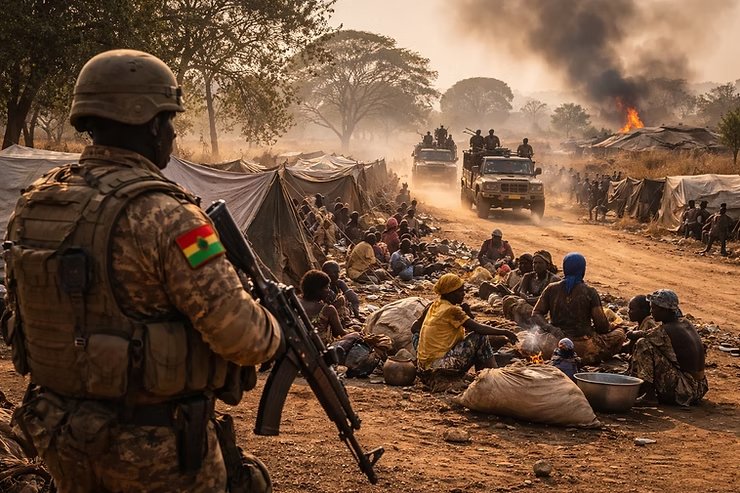
The government’s strategy—often described as “total re-conquest”—marks a departure from earlier defensive postures. National armed forces, supported by rapid-reaction units and civilian auxiliaries known as the Volunteers for the Defense of the Homeland (VDP), have launched sustained offensives to reclaim areas long outside state control.
Military communiqués in early 2026 report:
- The recapture of several strategic zones in northern and eastern provinces
- The dismantling of insurgent logistics corridors
- Large-scale neutralization of militant fighters
These operations are designed not merely to repel attacks but to restore permanent administrative presence, reopen roads, and enable displaced populations to return.
Insurgent Adaptation and Persistent Threats
Despite these advances, armed groups linked to transnational jihadist networks remain resilient. Organizations such as JNIM and Islamic State in the Greater Sahara continue to wage asymmetric warfare.
Their tactics include:
- Siege warfare against isolated towns
- Ambushes on supply convoys and trade routes
- Targeted attacks designed to undermine economic recovery
A February 2026 attack near Titao, which killed several cross-border traders, underscored how insecurity continues to disrupt regional commerce and civilian life.
The Technological Dimension of the Conflict
One of the most notable developments is the emergence of drone warfare in the Sahel. Insurgent factions have increasingly deployed commercial drones for reconnaissance and, in some cases, weaponization.
Burkinabè forces are now investing in:
- Electronic warfare systems
- Signal jamming technologies
- Counter-drone detection capabilities
This signals a broader modernization effort as warfare in the Sahel evolves beyond purely guerrilla tactics into a hybrid battlespace.
2. A New Geopolitical Axis: The Alliance of Sahel States
Burkina Faso’s military strategy is mirrored by a profound diplomatic realignment. The country has moved away from traditional Western partnerships and deepened cooperation with neighboring military-led governments through the Alliance of Sahel States (AES), alongside Mali and Niger.
From Regional Isolation to Strategic Bloc
The AES represents an attempt to construct a self-reliant security architecture rooted in:
- Intelligence sharing
- Joint military planning
- Mutual defense commitments
This framework emerged after tensions with ECOWAS, which had pushed for rapid democratic transitions following military coups in the three countries.
Deepening Ties with Russia
At the same time, Ouagadougou has strengthened relations with Russia, expanding cooperation beyond battlefield support into governance and administration.
Recent agreements include:
- Training Burkinabè civil servants in Russian institutions
- Digitalization of public administration systems
- Technical assistance aimed at strengthening state capacity
This reflects a broader trend across parts of Africa where governments seek alternative development and security partners outside traditional Western frameworks.
Reopening Dialogue with Algeria
In a sign that diplomacy remains fluid rather than binary, relations with Algeria have recently improved after a year-long dispute. The restoration of ambassadors in February 2026 suggests renewed cooperation on border security and long-discussed energy projects such as the Trans-Saharan Gas Pipeline.
3. Political Restructuring and the Dissolution of Parties
While the government emphasizes military urgency, its domestic political decisions have triggered intense debate.
In January 2026, authorities formally dissolved all political parties, arguing that partisan competition risked fragmenting national unity during wartime. The move effectively pauses electoral politics and extends the transitional period without a clear timetable for civilian rule.
Government Justification
Officials present the measure as a wartime necessity intended to:
- Prevent political polarization
- Centralize decision-making
- Focus national resources on security and reconstruction
Concerns from Observers
Critics, including civil society groups and international watchdogs, warn that:
- The absence of formal opposition may shrink democratic space
- Long transitions risk becoming entrenched
- Public debate may be constrained at a time when policy choices are most consequential
Burkina Faso thus faces the difficult balance between state consolidation and political pluralism, a challenge common in countries confronting prolonged insurgencies.
4. Economic Growth Amid a Deepening Humanitarian Emergency
Perhaps the most striking feature of Burkina Faso’s current trajectory is the coexistence of macroeconomic recovery with widespread human suffering.
Signs of Economic Resilience
International financial institutions such as the International Monetary Fund and the World Bank project approximately 5% GDP growth in 2026.
Key drivers include:
- Reopening of major gold mining operations
- Strong agricultural output in relatively secure regions
- Government spending focused on defense and rural infrastructure
The national budget—valued at roughly $6.15 billion—prioritizes territorial stabilization and food production, reflecting the belief that security and economic revival are inseparable.
A Severe Humanitarian Gap
Yet beneath these aggregate gains lies a stark humanitarian reality:
- Around 4.4 million people require urgent assistance
- Nearly 2 million remain internally displaced
- Nutrition programs face funding shortfalls approaching 70%
- Millions of children remain vulnerable to acute malnutrition
This “dual reality” illustrates how national growth figures can mask localized devastation, particularly in conflict-affected provinces where markets, schools, and clinics remain disrupted.
A Nation at a Crossroads
Burkina Faso in 2026 is neither collapsing nor stabilized—it is navigating a volatile transition defined by simultaneous assertion and fragility.
- Militarily, it is attempting to reverse years of territorial loss.
- Diplomatically, it is forging a new Sahel-centered and Eurasian-leaning alignment.
- Politically, it is experimenting with centralized governance in the name of unity.
- Economically, it shows resilience even as humanitarian needs surge.
The success or failure of this strategy will depend on whether security gains can translate into durable governance, whether new alliances deliver long-term capacity rather than short-term relief, and whether economic recovery can reach the millions still living on the margins of the conflict.
For observers of the Sahel, Burkina Faso has become a critical test case: Can a state fight an entrenched insurgency, redefine its international partnerships, and rebuild institutions—all at once?
The answer will shape not only its own future, but the geopolitical and security landscape of West Africa for years to come.
Conclusion: The High Stakes of a Nation in Transition
Burkina Faso’s path in 2026 is defined by urgency. The state is attempting to reclaim territory, reassert sovereignty, and redesign its alliances while managing one of the most severe humanitarian crises in its history. These simultaneous pressures have forced leaders to prioritize security and centralization, betting that stability must come before political normalization and long-term development.
Yet the coming years will test whether military gains can evolve into lasting governance, whether new partnerships can translate into institutional strength, and whether economic growth can meaningfully improve the lives of millions affected by displacement, hunger, and insecurity. Success will depend not only on battlefield outcomes, but on rebuilding trust between the state and its citizens, restoring services in recovered regions, and ensuring that recovery reaches beyond urban centers and strategic industries.
Burkina Faso is no longer simply confronting an insurgency—it is redefining its national model under extraordinary strain. The decisions made during this transitional period will determine whether the country emerges more sovereign and resilient, or remains caught in a cycle of conflict and emergency. For the Sahel as a whole, its trajectory may well become a blueprint—or a warning—for the region’s future.