

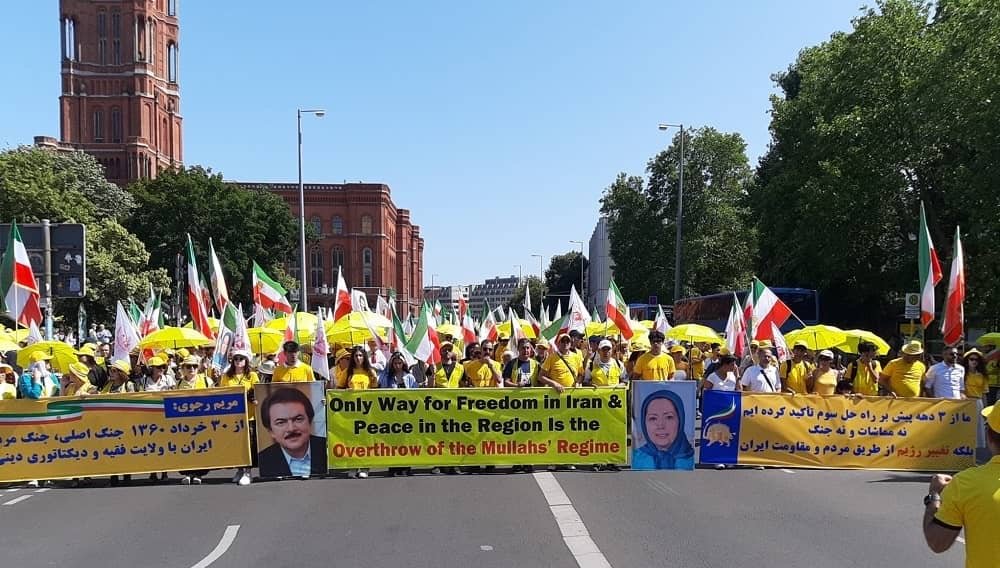
Germany hosts one of the most dynamic and politically engaged Iranian diaspora communities in Europe, shaped by decades of exile, resistance, and ongoing ties to developments inside Iran. From the post-revolutionary waves of the 1980s to the more recent arrivals after 2015, this community reflects a complex mix of political memory, activism, and differing visions for Iran’s future. In this context, Vida Niktalean, a Germany-based activist and founder of the Association of Women for Democracy in Iran, shares her perspectives shaped by personal loss, long-term engagement, and continued involvement in opposition activities.
The reflections presented here also point to the deep divisions within the Iranian opposition abroad, as well as the broader debates surrounding war, foreign intervention, and internal change. Competing narratives, historical interpretations, and political strategies continue to shape the discourse among exiled groups. Against a backdrop of regional tensions and internal unrest, these voices illustrate both the persistence of resistance and the uncertainties surrounding Iran’s political trajectory.
Vida Niktalean
The Iranian diaspora in Germany is quite large; I believe it’s over 150,000, though I’d need to double-check the exact figures. It is a very significant and diverse community, with a particularly large presence in Hamburg. We’ve seen manynewcomers arriving from Iran, especiallysince 2015.
The first major wave was in the 1980s, when executions in Iran surged. After that, things settled slightly, but over time, many more have fled. As I mentioned, since roughly 2015 and following the recent uprisings, many have sought asylum here.Most are German-Iranians, but except for those who came strictly for economic interests, almost everyone here is a political refugee.
Association of Women for Democracy in Iran
I have been in Germany since 1986. Throughout this time, I have closely followed the news and the ongoing human rights violations in Iran. My connection to the PMOI (Mujahedin-e-Khalq) began back in Iran because my family members were victims of the regime; some were executed, and my father was a political prisoner despite having done nothing wrong. That is why I came here.
I could never forget my country. I couldn’t just live a ‘normal’ life; even while studying here, my thoughts were always with Iran. I took part in demonstrations and events across Europe whenever I could.
Ten years ago, we decided to found an organization here. While there are other groups, I founded the ‘Association of Women for Democracy in Iran.’ I was inspired by the role of women within the Mujahedin—the idea that women possess great power and can bring about significant change. That inspiration led us to establish this association.
I can say with pride that this association remains very active. Our membership has grown, and we maintain extensive contacts within Iran, from which we receive constant updates. Our work focuses on raising awareness through public relations and meetings with politicians.
We organize demonstrations, events, and all sorts of activities. Most often, we hold photo exhibitions. For instance, on the anniversary of a mass execution or whenever an unjust execution occurs in Iran, we immediately mobilize to launch an action or an exhibition. We don’t plan these a month in advance; if something happens today, we are mobilized to respond and voice our opposition immediately.
Europe has pursued an appeasement policy toward Iran
There was a time when the ‘appeasement policy’—which has unfortunately lasted for 40 years and led to the current war—resulted in some restrictions, but never enough to stop us. You may have heard the various smear campaigns and defamations directed at the PMOI.
I believe the reason for this is that the PMOI is the strongest and most active organization fighting the regime. They were organized, they had a liberation army, and they built resistance cells throughout Iran. This is why the propaganda against them has intensified. Imagine this: there are over 600 books,hundreds of films, TV series, and thousands of reports published by the regime specifically targeting the Mujahedin.
This propaganda eventually has an effect, especially on those who lack access to accurate information. Through appeasement, some of these narratives were even adopted by Western policies. However, as supporters, we are free to move and act as we wish here.
Shah kissed the robes of the Mullahs
The PMOI (Mujahedin-e-Khalq) was founded 60 years ago, as most people know. Even back then, they began fighting against injustice and the repressive environment under the Shah’s reign. They were imprisoned and executed. When the Revolution happened, those who were still in prison were finally released. This is why the ‘Pahlaviists,’ as I call them, harbor such hatred toward the Mujahedin.
Personally, I have always supported every voice raised against the regime on European streets. I have never taken action against them. My colleagues and I have only focused on ‘awareness work.’ Our goal is to retell history—the history that is being distorted by propaganda and media—so that people do not forget.
Think about it: if the Shah’s era was so perfect and everyone was so happy, why did the Revolution happen? The reality is that the elites were in prisons, while the Shah was busy ‘kissing the robes’ of the Mullahs. As Mr. Massoud Rajavi says, the Shah’s true successor wasn’t the Crown Prince Reza Pahlavi; it was Khomeini. This is because the Shah imprisoned the students, the intellectuals, and those who understood politics and economics, effectively handing power to the Mullahs.
We didn’t have many universities; we mostly had mosques. Over 20,000 mosques were built during his time. This ‘mental fundamentalism’ helped him keep the people subservient, leaving society oblivious to the looming danger.
The Shah was not a modern figure with his unveiled wife
And now, the same thing is happening, but in reverse. Through years of media propaganda, Pahlavi supporters—many of whom are young people who weren’t even alive then—have been misled. They’ve only seen the pictures. They see images of the Shah or his wife in elegant clothing, or women without headscarves, and they assume everything in Iran was wonderful. They think people just suddenly ‘went mad’ and overthrew the regime for no reason. They don’t stop to ask ‘why.’
Consequently, they harbor an immense hatred toward us. We are attacked and insulted by them at every event we hold, even when we gather to mourn those executed in Iran—a pain that should unite all Iranians.
Now, they have this immense hatred toward us. We are attacked by them. We are subjected to so many insults; it doesn’t matter what kind of event we hold or what the occasion is—even if it’s about someone being executed, which is painful for all Iranians—they still target us.
Whenever an event occurs in Iran that requires us to demonstrate immediately, we get heckled. This has become very intense since January. It used to be less frequent, very rare even, but now it has increased significantly. I can see why they have done this so systematically across all countries. I’ve seen images from America, Canada, and all over Europe—not just one or two, but many.
They are doing this because they want to push anyone with a different mindset—whether they are Mujahedin, Leftists, or ‘Woman, Life, Freedom’ activists—off the streets. They want no one else there so that when crowds join them, they can show the world they have the largest following.
In Hamburg, for example, it is well known that they exploit newly arrived Iranians. They give them a stage and a platform, and in return, these people must chant slogans like ‘Death to the three oppressors: Mullahs, Leftists, and Mujahedin’ and ‘Javid Shah’ (Long live the King). By doing this, they get recognized as activists and receive their papers.
But where were they during all those years when the Mujahedin were fighting against the regime? They were taking their vacations in Iran. They used the money they earned here to live very well back there. They bought houses, traveled back and forth; they had economic interests both here and in Iran. Meanwhile, we slaved away. We worked hard because we have principles.
Arm in arm: Pahlavi supporters and regime moderates
When you oppose this regime, when you truly know it, you know you must stand firm against it. You must give up everything you have, because this isn’t a game. The bitter truth is that this regime is merciless toward its opponents. You can see it; perhaps you’ve heard that in the last three weeks, eight members of the People’s Mujahedin have been executed. Some had been in prison for years—one for 20 years. Eleven more are currently on death row, and they might soon be executed as well, though we hope not.
These are very grave matters. But to answer your question: yes, we are often attacked, but I have never seen a Mujahedin supporter go to their demos to stage a counter-protest.
If you look closely at who is on Reza Pahlavi’s team, you’ll see they are almost all people who were part of the ‘reformist’ camp in Iran just a few years ago. They were reformists within this government and played their part in it. For instance, there is one person—I can’t recall his name right now—who was always with Khamenei, worked in his inner circle, very close to him. And now, he is with Reza Pahlavi.
What is happening there is quite concerning, but the whole thing is based on propaganda, false figures, and targeted media work that has amplified this ‘show.’ As I have come to understand: the Mullah regime and the Shah/Reza Pahlavi regime both share the same mentality. One is Islamism, the other is secularism or whatever, but the mentality is identical.
There is only one war: the war between Iranians and the Mullahs
I want to answer that question this way: For me, there is only one war. And it is the war that has been ongoing for 47 or 48 years between the Iranian people and the regime. This war reached this point because the regime was tolerated for far too long. Their machinations were endured for 47 years. The policy of ‘appeasement’ continued to the point where everyone knew this war was inevitable. We have always said this war is between the Iranian population and the regime.
History shows, from previous world wars, that such conflicts do not necessarily lead to the overthrow of a regime. We know from experience that this regime is not reformable; it must be overthrown. And only the Iranian people can do that. No foreign war can achieve this. War only brings damage; it kills people and destroys a country’s infrastructure. It doesn’t matter if an Iranian dictatorship is in power or another; the point is that the people built everything. They weren’t even paid well for it, but they built that infrastructure with their heart and soul. After it was built, the people didn’t benefit; the government exploited them, and now it is all being destroyed.
As Maryam Rajavi has always said, we stand for peace and freedom. Freedom following peace is crucial. One must be very careful when speaking of ‘peace’ so as not to be accused of being pro-regime, but that is not the case. We want peace and freedom for the people in Iran. It is always about the people—those who are oppressed and bombed.
In January, we had so many deaths because the regime suppressed and shot people in the streets. And now, due to the war, I heard on German television that over 200 children have been killed so far.
Therefore, we do not welcome this war; we say war is not the solution. Something else must be done. I can tell you the solutions if you wish. It is a very dangerous situation in Iran right now.
The protests against America or Israel are not my problem
You ask if I protest against the US and Israeli attacks on Iran. No; I only attend demonstrations that make sense. I go where my voice can be heard. The protests against America or Israel are not my problem—my problem is the Iranian regime.
One of the damages this war has caused is that regime supporters in Germany have become emboldened. They are now taking to the streets with their flags, showing a brazenness I haven’t seen in 40 years. These are human rights violators.
After the executions in January, the regime had lost all face; they didn’t have the courage to show themselves. But now, due to this war, they have become so arrogant that they join leftist or anti-war rallies, waving Iranian flags and chanting for Khamenei.
The solution is neither the ‘appeasement policy’ of the last 40 years nor a war from the outside. The solution is an organized uprising and transformation from within Iran. As long as this war continues, there will be no uprising.
The regime has organized its followers on the streets because they are terrified of a domestic revolt. I believe the regime doesn’t even want this war to end because they fear the aftermath. The economic and human rights situations are dire; people have nothing left to lose. It will be extremely dangerous for the regime once the war stops.
Pahlavi is a wall between the Iraniansand their freedom
You expressed concern about a ‘dangerous’ Pahlavi regime backed by Trump or Netanyahu. In my view, Pahlavi is merely a wall standing between the Iranian people and their freedom. He calls for war, but we do not want war because the Iranian people seek peace and liberty through their own strength.
Pahlavi will never come to power; he has no resistance cells in Iran and no one willing to give their life for his cause. A movement must be organized from the inside, and only an organized resistance like the PMOI (Mujahedin-e-Khalq) is capable of this. They have strong, active resistance cells on the ground.
Regarding your question on whether the regime will become more aggressive after the war: I believe the regime will get more aggressive, but the people will become even more so. The resistance is alive; over 120,000 people have been executed in prisons. We demand that Europe closes all Iranian consulates and embassies. No more trade with the regime. If you sit at a negotiating table with them, the abolition of the death penalty and human rights must be an absolute requirement.
The ‘red line’ for Europe has always been refusing to recognize the National Council of Resistance of Iran (NCRI). This is not a neutral decision; it is a clear political and moral choice with consequences. The solution lies neither in war nor in appeasement, but in supporting the right of the Iranian people to struggle for democratic change. Those fighting the regime from within are not terrorists; they are people calling for freedom, fighting and dying for it.