

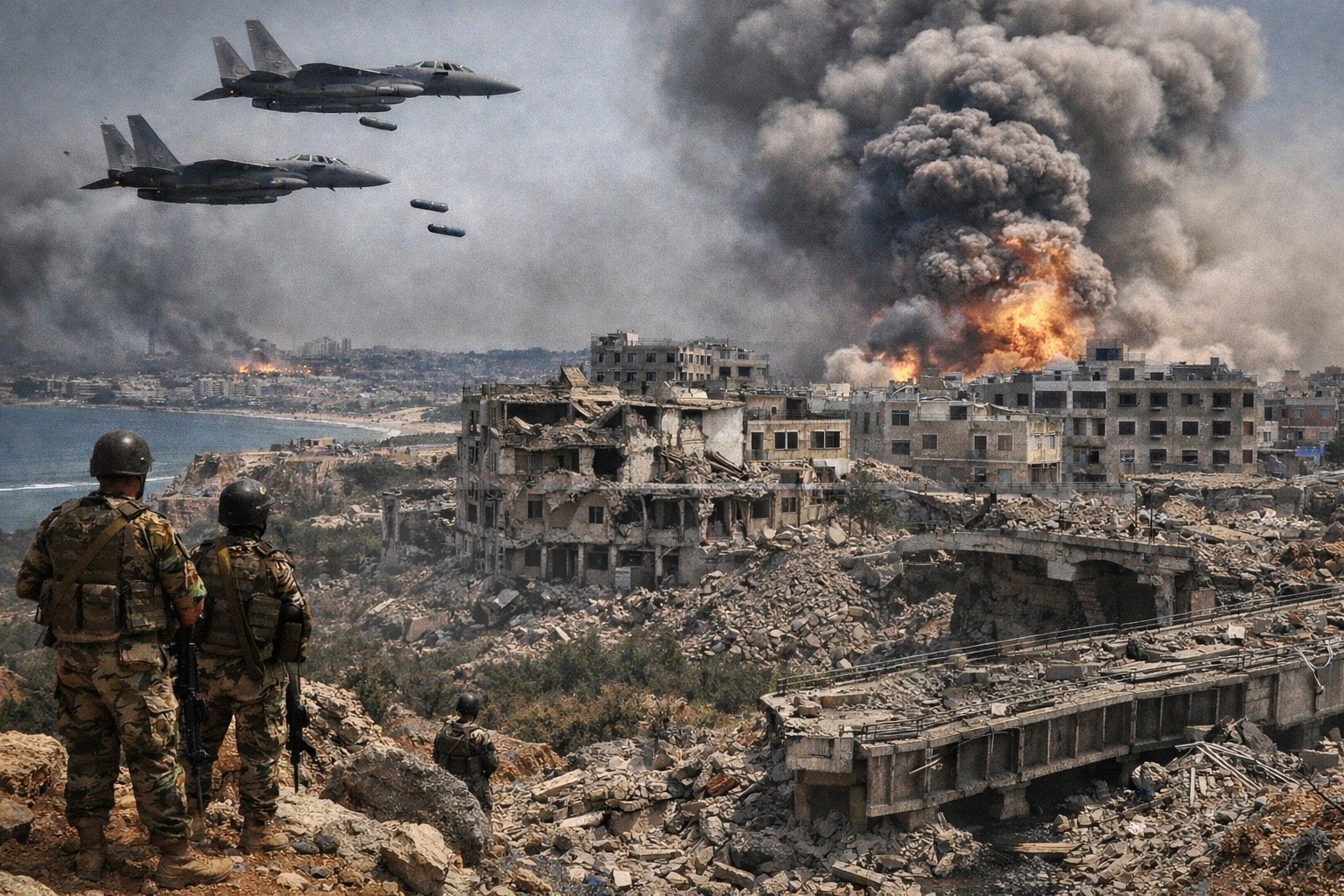
Lebanese MP Abdel Rahman al-Bizriframes the issue of arms in Lebanon within the broader and highly sensitive debate surrounding Hezbollah’s weapons, particularly at a time of Israel’s renewed military escalation in southern Lebanon. As of April 2026, Israeli operations—including large-scale airstrikes, ground incursions, and the establishment of a de facto security zone—have significantly intensified pressure on Hezbollah’s military presence and, by extension, on Lebanon’s internal political balance.
In this context, al-Bizri’s emphasis on the exclusivity of arms under state authority directly intersects with growing international and regional calls for Hezbollah’s disarmament, not merely as an internal Lebanese issue but as part of a broader security arrangement linked to ongoing Israeli military objectives.
At the same time, al-Bizri approaches the question of Hezbollah’s disarmament with caution, situating it within a comprehensive national security framework rather than a purely coercive or external agenda. He argues that sustainable stability cannot be achieved solely through military pressure—whether domestic or Israeli—but requires strengthening Lebanese state institutions, particularly the army, alongside democratic governance and socio-economic resilience. While Israeli operations and regional dynamics—including Iranian influence—shape the urgency of the debate, al-Bizri underscores that any durable resolution must emerge from internal consensus and legitimate state authority. In this sense, the issue of Hezbollah’s weapons becomes inseparable from Lebanon’s sovereignty, electoral processes, and its attempt to navigate between external pressures and internal political cohesion in an increasingly volatile regional environment.
Abderrahman al Bizzi
The main reasons behind the call for Hezbollah’s disarmament are linked to the agreements signed by the Lebanese government, as well as the understandings that Lebanon concluded through the Quintet Committee with Israel, which require a form of exclusivity of weapons on Lebanese territory, meaning that this exclusivity should be under the authority of the Lebanese state.
In addition, the presidential oath speech delivered by the President of the Republic before the Parliament upon his election by a large majority also emphasized the principle of exclusive state control over weapons and the extension of state sovereignty over all Lebanese territory. Likewise, the ministerial statement on which the current government gained confidence, and in which ministers from Hezbollah and the Amal Movement participated, included a clear and explicit provision regarding the exclusivity of weapons.
However, Lebanon today needs a comprehensive national security policy rather than merely a new defense policy. National security is linked to multiple components: part of it is defense, part of it is internal security, but another part is social security, which includes health, education, social protection, environmental protection, and state modernization, [meaning reforms and improvements that facilitate citizens’ daily lives], among other elements that improve the lives of citizens.
The Lebanese Army, which has a very clear understanding of the national landscape and available capabilities, and which enjoys the trust of all Lebanese people across their different affiliations, political views, and backgrounds, is in need of logistical support in order to carry out the tasks assigned to it. The national doctrine of the Lebanese Army, the discipline of its members, the trust of the population, and the experience it has gained in the past all represent strong assets. However, at the same time, there are capabilities that must be made available to the army, whether in terms of equipment or personnel, so that it can deploy effectively across Lebanese territory.
In Lebanon, we do not prefer to use the term “disarmament,” but rather we prefer the expression “exclusivity of weapons,” [meaning that only the state should possess and control arms].
The exclusivity of weapons is an essential part of the agreements and understandings that have reduced military activity and aggression against Lebanon.
However, unfortunately, despite Lebanon’s commitment to this matter, and despite the Lebanese Army providing periodic reports to the Council of Ministers—reports that are viewed positively both at the level of the Council of Ministers and at the level of the Quintet Committee led by the United States and including France—Israeli aggression against Lebanon continues. This aggression is expanding continuously, reaching areas even north of the Litani River and targeting civilian locations, [that is, not limited to military targets].
The issue of Iranian influence on the question of arms exclusivity is connected to regional developments, regional positions, and regional influence at certain stages. However, we hope that all regional actors will play a positive role, especially since the main and fundamental change today is occurring on the Syrian scene. Syria is now moving in a different direction compared to what it was in previous years and decades.
As long as Palestine remains under Israeli occupation, Syria remains the only neighboring country through which Lebanon’s connection to the Arab world extends. Lebanon is currently working to rebuild stronger relations with the Arab system, [i.e., Arab states and regional institutions]. Therefore, restoring Lebanon’s Arab role while maintaining its regional friendships is a key objective we rely on.
The issue of exclusivity of weapons also relates to parliamentary elections. Some argue that elections should not be held until it is ensured that the principle of exclusive state control over weapons has been fully implemented across all Lebanese territory. Others argue that Lebanon cannot postpone parliamentary elections, because postponement would greatly harm Lebanese interests. Therefore, it is likely that parliamentary elections will take place regardless of whether full state control has been completely achieved.
The only factor that could delay or affect elections, or lead to their postponement, would be large-scale Israeli aggression against Lebanon and the continuation of Israeli attacks. The decision of the Lebanese Council of Ministers is clear and explicit: the only legitimate authority is the state. Therefore, the existence of any other weapons in Lebanon is considered illegitimate and ineffective, and cannot be used either in elections or in any other context. This is likely to have a significant impact on the electoral process.