
War is not the answer, and change in Iran will not come from the air. It must come from within the country, be homegrown, and be brought about by the people of Iran and the organized structure resistance.
The ceasefire is welcomed because Iranian civilian infrastructure is not being destroyed and civilians are no longer being killed. When guns fall silent, an open space emerges for the Iranian people to come out onto the streets and again engage in protests like they did in 2026. The problems that led to that uprising—high prices, unemployment, inflation, and corruption—are still present. The regime is not able to solve them even now, and it is much weaker than it was before the war.
The Europeans who negotiated with the regime for so many years, it always promised to cooperate, but at the end of the day, it did not. For Mullah regime, a nuclear program is like a lifeline, it’s like a life insurance policy, and they were not about to give it up.
Ali Safavi
I’m a member of the National Council of Resistance of Iran (NCRI) Foreign Affairs Committee, and NCRI is a coalition of five different organizations and about 450 Iranian academicians, personalities, activists, representatives of Iran’s ethnic minorities that was formed in 1981 with the aim of toppling the regime in Tehran and establishing a democratic, secular, non-nuclear republic in Iran.
Its president-elect is Mrs. Maryam Rajavi, and she has presented a 10-point plan for post-Mullah Iran, which emphasizes free elections, freedom of expression, all individual freedoms, social freedoms. It believes in gender equality. It basically is committed to granting autonomy to Iran’s various nationalities. Iran’s mosaic of diverse nationalities comprises about 35% of the Iranian population or 37%. So they have the right to autonomy within theterritorial integrity of Iran. The NCRI opposes the Mullah Sharia law. It opposes the death penalty. It wants a non-nuclear Iran and, of course, wants peaceful relations with all of Iran’s neighbors.
Of course, one of the main organizations within the NCRI is the Mujahedin-e Khalq, which, of course, has been active since 1965, 61 years now. And it was formed to fight against the regime of the Shah, the corrupt dictatorship of the Shah. And initially when the Shah was overthrown, for two and a half years, the Mujahedin, although almost all of its leadership and 90% of its cadres were arrested and many were executed, actually today is the anniversary of the execution of several of their leadership by the Shah’s regime.
The organization quickly became the largest political party in Iran with its rallies, like 200,000, 300,000 people participated in, and its newspaper, Mujahid, became Iran’s largest circulation of newspapers with some 600 copies were sold daily across Iran, whereas the official newspaper of the regime circulation was something like 70,000.
It engaged in peaceful political activity until June of 1981, when Khomeini and the mullahs unleashed a reign of terror on the organization. There was a demonstration by a half a million people in Tehran in June of 1981, and the IRGC, the Revolutionary Guard, was ordered by Khomeini to open fire. Dozens were killed, hundreds were wounded, and thousands arrested. And of course, a wave of executions began on that day. Some 100,000 members and activists of the Mujahideen-e Khalq have been executed, including 30,000 in 1988, who were massacred based on a so-called fatwa by Khomeini. Men and women who were taken before two-minute trials, although none of them had been sentenced to death, they were retried, and if they remained steadfast and continued to support the Mujahideen, they were all hanged secretly and buried in mass graves.
And this story was left untold, and unfortunately, the international community, the United Nations, turned a blind eye on it until July of 2024, when the UN Special Rapporteur on Iran, Professor JavidRahman, produced a 66-page report that documented the 1988 massacre, describing it as a case of crime against humanity and genocide.
The Mujahideen have been fighting against this regime. They are very, very active inside Iran. In 2025, they carried out some 4,099 anti-repression operations against the Revolutionary Guard, against the paramilitary Basij and some institutions of repression.
During the January 2026 uprising, they conducted 630 different operations against the Revolutionary Guard protecting the protesters who were out in the streets. And on February 23rd, five days before the United States attacked Khamenei’s headquarters, 250 Mujahideen fighters, attacked the same compound. Some 100 were killed or detained, but 150 of them managed to withdraw. We gave the names of 82 of those who were killed or detained, including some as young as 18, some in their 60s, to the United Nations to follow up.
And most recently, in late March, early April, six members of the MEK resistance units, ranging in age from 34 to 67, were executed by the regime in Tehran, which made the news headlines all over, which goes to show that the organized opposition to the regime is very active, very potent, and of course, joined with the Iranian people, and can bring down the mullahs’ regime.
MEK exposed Iran’s nuclear program
The Iranian resistance and the NCRI, over the past many decades, has said that the solution to the crisis that the Iranian regime has caused in terms of suppressing the Iranian people, driving the country bankrupt with corruption, with mismanagement, high prices, unemployment, but also causing turmoil in the region like in Syria how they supported the dictatorship of Bashar al-Assad. They supported the Houthis in Yemen. They supported the Hezbollah in Lebanon, the Hashd al-Shaabi and the terrorist proxies in Iraq.
And of course, they had a nuclear weapons program, which, by the way, the NCRI exposed back in 2002. And they, of course, have a very, very sophisticated ballistic missile program and they manufacture thousands of drones. So we have said all along that the solution to this problem is not war, nor is it engaging with the mullahs of Iran.
In fact, in 2004, when Mrs. Rajavi went to the European Parliament, she told the parliament that if you want to resolve the Iranian problem, you must work with the Iranian people and with the Iranian opposition, recognize the struggle to bring freedom to Iran. Appeasing it and giving it concessions will be counterproductive.
And so I think events of both the 12-day war like in June of last year and the 40-day war this year vindicated what she said. This war became inevitable precisely because of the policies of Western governments toward the regime in Tehran. It emboldened it. It encouraged it, thinking that it can take the international community hostage. And so it refused to abandon its nuclear weapons program.
The Europeans who negotiated with the regime for so many years, time and time and time, it always promised to cooperate, but at the end of the day, it did not, which is why the United Nations imposed six resolutions against the regime, but the mullahs didn’t care because for them, a nuclear program, their nuclear weapons program, is like a lifeline, it’s like a life insurance policy. And they were not about to give it up. They saw the experience of Iraq, they saw the experience of Libya, and they also have seen what is happening in Ukraine.
Iraq and Libya were destroyed because of their chemical programs
These countries, I guess, Ukraine had nuclear weapons and Syria and Iraq were working toward getting nuclear weapons. And of course, once that capacity was eliminated, then you saw what happens to Iraq. It was invaded, and of course, in one of the biggest foreign policy blunders of the United States under George W. Bush, in addition to hundreds of thousands of people killed, the destruction of Iraq, even some 4,500 Americans killed and $3 trillion of cost that it had for the United States.
Iraq is now basically controlled by the Iranian regime, something that the mullahs could not accomplish in eight years of war against Iraq. They accomplished once the government of Iraq was overthrown by the United States. And now, there’s problems about who’s going to become the prime minister. Nouri al-Maliki, of course, is a stooge of Iran, and Soudani is not any better.
So this is why we have said that war is not the answer. And because we do not believe that change in Iran will come from the air, it must come from within the country, it must be homegrown, it must be brought about by the people of Iran and by the organized structure resistance. And when a ceasefire was announced last week, Mrs. Rajavi welcomed the ceasefire, said that this was an appropriate decision at a very critical time because the regime takes advantage of war to suppress the Iranian people.
You saw that during the war, it not only arrested a lot of people, it executed at least 13 dissidents, six from the Mujahideen, and seven people who had been arrested during the January 2026 uprising. And so we believe that, and even now as we speak, the regime has brought its siege and its supporters into the streets of Iran every night, every day, trying to close, if you will, the political space for the Iranian people to vent their anger.
And so that is why our position was that there was no need to go to war in Iran if the international community had, as we said 22 years ago, reached out to the Iranian people and supported our movement to bring about democracy in Iran.
Iran doesn’t need nuclear energy
We were the ones who exposed it back in 2002. If it was not for the revelations that we made in Washington, actually, one of my colleagues in Washington had a press conference in 2002 and he revealed for the first time the existence of the nuclear enrichment site Natanz, which was bombed, by the way, by the United States during the 12-day war, and also the heavy water facility in Arak in central Iran.
And that triggered IAEA involvement and, of course, all the inspections and the sanctions that were imposed on the regime. Before we made that revelation, nobody knew about the fact that the regime had the nuclear weapons program active because the mullahs had not told the international community. And ever since, we have made some 130 revelations about Iran’s nuclear weapons program.
Iran doesn’t need nuclear energy. Iran has at least 300 years’ worth of gas and oil, most of it untapped. And in fact, nuclear energy is not very cost effective. It’s much more expensive than fossil fuels that Iran has plenty of. Iran has the second largest gas reserves, and it was the fourth largest exporter of oil before the sanctions came in and it lost its ability to export as it used to before.
Mullah regime is much weaker than before
How and why the United States or Israel have people working as informants for them, to be honest, I don’t know. The fact is that ultimately, those type of activities will not bring about the desired result. Khamenei has been dead now. He was killed on the 28th of February. The top leaders of the IRGC have been killed, quite a few of them, I think at least 60 top officials of the regime, both from the military and civilian have been killed, but the regime is still in power.
And, of course, it is much weaker than before, there’s no question about that, but… At the end of the day, it is the people of Iran, combined with the organized resistance, can topple this regime. And as to why somebody would provide information to the U.S. and to Israel, maybe they offer them some financial incentives, I don’t know, but because that’s not the kind of issue that we focus on or have any information on. But people do those things for different reasons.
But I must also add that the regime executes a lot of dissidents charging them with espionage and working for foreign governments, because this regime has always, ever since it came to power, has described any person, any party, any organization that opposes its repressive policies as agents of the West, that is, to justify their imprisonment, their torture, and their executions.
Let me remind your viewers that in the 1980s, when thousands of members of the Mujahideen were arrested, some as young as 13 years old, and were executed, they were wrapped in American flags to say that they are agents of America, which they were not, of course. They were patriotic Iranians who wanted to free Iran from the oppression of the mullahs. So I come back to my original statement.
The only way, the only way to topple this regime and end instability in the Middle East is to recognize the Iranian people’s right to fight against this regime and of course the organized resistance. Remember that a few hours after Khamenei was killed, the NCRI announced the formation of a provisional government. And this government, once we succeed in toppling the regime, will hold free and fair elections within six months of the regime’s overthrow for the election of a constituent assembly that will draft the future constitution of a republic for Iran.
And I emphasize republic because we are also opposed to any form of monarchy and returning to the days of the Shah because we believe that the choice for the Iranian people is neither monarchy nor theocracy. You need to have a representative government, a republic, that is elected through the direct vote of the Iranian people.
MEK is like a liberation army inside Iran
Well, the Mujahedin-e-Khalk are very active inside Iran. As I said, they have actually since 12 years ago, since 2014, the Mujahedin built, worked on building the resistance units inside Iran. It’s like a liberation army inside Iran. You know, we had a liberation army across Iranian border in Iraq, which had tanks and the armored vehicles, lots of weaponry. But when the United States invaded Iraq, we voluntarily handed over all that weapons to the United States in return for them protecting us, which of course, a few years later, they did not do that and they handed over the protection of Camp Ashraf in Iraq to the Iraqi government, the Maliki government. And there were seven attacks on the Mujahedin and 140 members of the Mujahedin were killed by pro-Iran militias and by the government of Iran.
We now have the semblance of a liberation army inside Iran. And they are very active, but of course, it is not only the Mujahedin who are fighting against the Mullahs. There are other young men and women who are opposed to this regime, and they are also fighting, as are other sectors of Iranian society, but of course, our movement is giving direction and guidance and protection to all those who want to topple this regime. And so, because I don’t want to overstate what we are doing inside Iran and to say every act of resistance against this regime is carried out by the Mujahideen. We are the biggest and the most active, but there are other individual people or other people in other parts of Iran who also engage toRevolutionary Guard. So that is our position.
Our views toward all the countries in the region is that once this regime is overthrown, our foreign policy must be, is actually based on peaceful coexistence with all of our neighbors.
When guns fall silent, the streets will open to demonstrators
First of all, the fact that there has been a ceasefire now. We welcome that because the Iranian civilian infrastructure and Iranian civilians are not being killed. And when guns fall silent, then there will be an open space for the Iranian people to come out onto the streets and again engage in protests like they did in 2026. The fact is that the problems that led to that uprising, namely high prices, unemployment, inflation, corruption, all those problems are still there. And this regime cannot solve them even now because it is much weaker than it was before the war.
Now, as to whether the conflict will resume, we don’t know. We have to wait and see whether the Iranian regime will finally give up its enrichment uranium, agrees to the zero enrichment, and it dismantles its missile program. I think what happens moving forward depends on what the regime in Tehran does, although we have been very, very quick to say, as Mrs. Rajavi said in her statement when ceasefire was announced, that in any negotiations with the regime in Iran, that the issue of human rights, stopping executions, and arrest of people who oppose this regime must also be discussed.
And the problems with this regime is not just its nuclear weapons program, it’s not just its missile program, it’s not its intervention in the affairs of countries in the region, but also the way it treats its people. And so any agreement that ignores that is not complete, although if we go by history, the mullahs have shown that they are masters of denial, deception, and duplicity. And every time they say something, but they do the exact opposite. In the past few days, there were some discussions, some reports that the regime has agreed to give up its 60% enriched uranium, that it has agreed to not enrich uranium, and it had agreed to reopen the Strait of Hormuz. Well, today we heard, they said, no, they will not give up their enriched uranium, they will not stop enriching uranium, and they have blocked the Strait of Hormuz. And so this is the kind of regime you are dealing with, which is why we say talking to this regime is not the answer. Now, after 47 years, it is time for the international community and also for Iran’s neighbours to recognize that the only way you will see peace in the Middle East is for the toppling of this regime and the establishment of a democratic republic that wants to live in peace and harmony with the rest of its neighbors.
The people of Iran will topple the regime not foreigners
Well, the regime has become significantly weakened. There is no question about that. And we do not count on foreign powers to topple this regime. This regime will not be toppled from the air. And I don’t think anybody has the appetite to send a million soldiers to Iran to fight on the ground. You know, it took 200,000 soldiers in Iraq, and Iraq, of course, was mostly flat land and it was, I guess, one third the size of Iran and one third the population of Iran.
Iran is very different. The terrain is very different. It’s a huge country. And so it would be an extremely costly military undertaking to topple it by the use of foreign troops. It will not be toppled. It is the people of Iran joined by the organized resistance that can topple this regime. And it will happen. There’s no question about that. So this is why we have said that instead of engaging in war with Iran, recognize the right of the Iranian people recognize the provisional government that the NCRI has announced, and at the same time, make a clearer statement that monarchy and the remnants of the Shah’s regime have absolutely no place in the future of Iran.
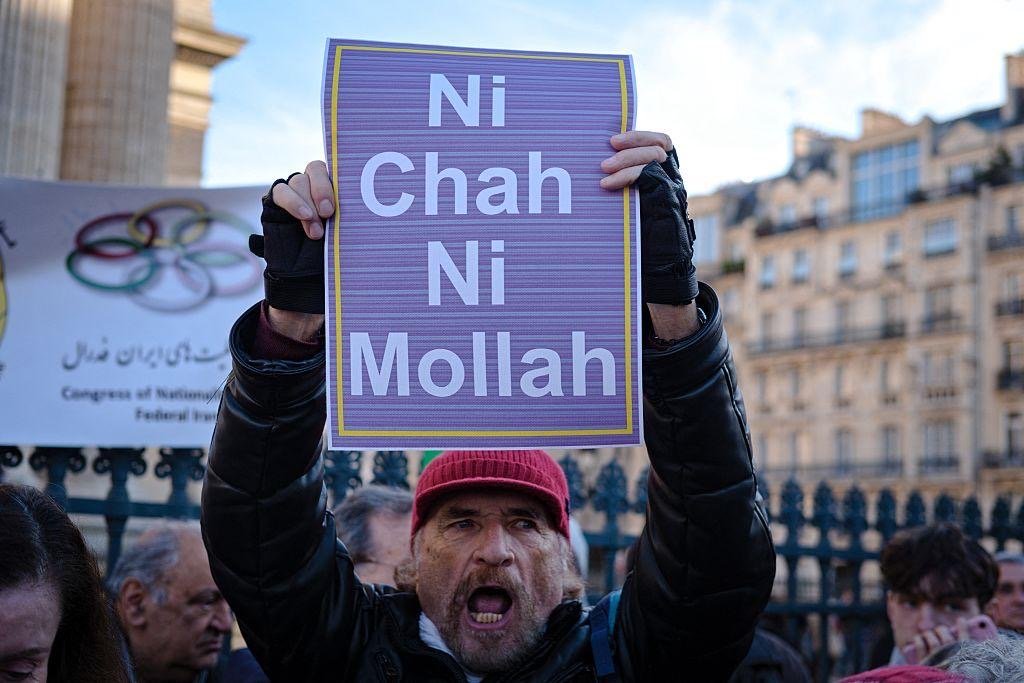
Back in 1979, I remember, because I was active in the anti-Shah movement at that time, the choice for the people of Iran was whether monarchy or a theocracy. Now, 47 years later, now, that choice cannot be the choice. There is a third choice, and that choice is a democratic republic, which is why, as I’m sure we very much oppose the remnants of monarchy and the son of the Shah was calling for bombing Iran and even taking Iran back to the stone age, which is against the national interests of the Iranian people. But he says that because he doesn’t have anybody on the ground to fight for him. He was banking on the U.S. and Israel to topple the regime and take him to Iran, and of course, that hasn’t happened, and it will not happen.
The people of Iran, after 120 years of dictatorship, first the Pahlavi dynasty and then the mullahs’ regime, reject both. They want democracy, and they have fought and died for that, and I’m sure that they will succeed, and we will help them. reachthat goal. But of course, the regime is much, much weaker, and once the drums of war stop, then you will see people coming out onto the streets.
And of course, as we speak, the resistance units are carrying out their operations all across Iran, and we will continue the fight. I understand that this is not an easy fight. It requires sacrifice. It requires taking risks. It requires organization, but we have proven that we are willing to do all those things with our supporters, our members in Iran fighting, and we are organizing.
And of course, we have tremendous support internationally. 4,000 parliamentarians in 57 countries across the world support our movement. 125 former world leaders, presidents, prime ministers, support our movement. So we have both the political alternative and, of course, the people on the ground to bring about change and democracy in Iran and have good relations with all of our neighbors, including the brother nation of Turkey.