
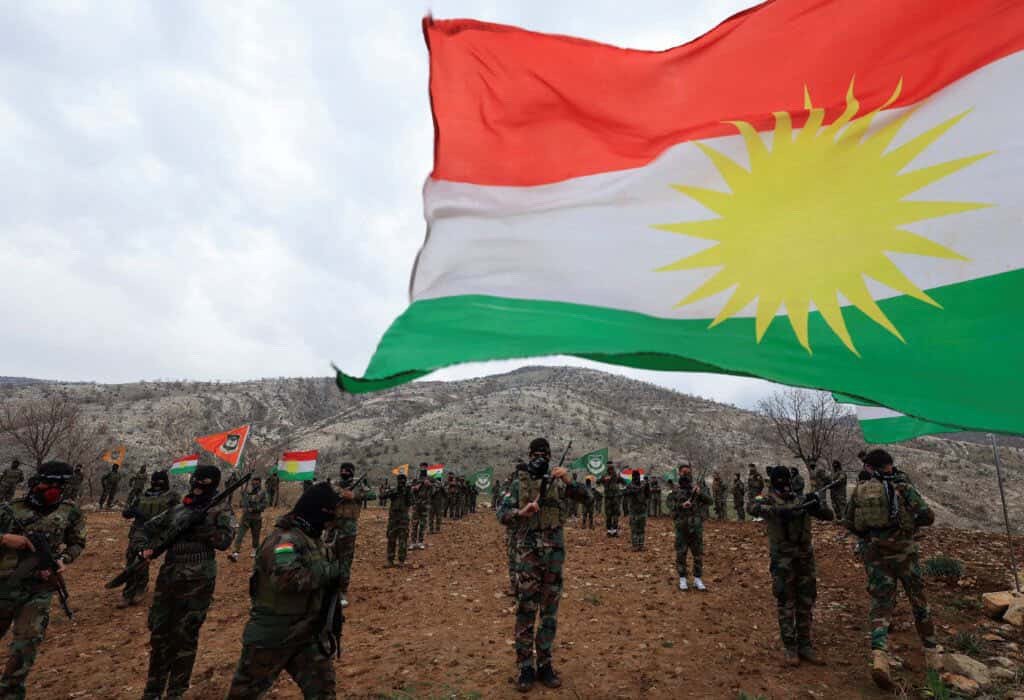
Rojhelatî people (Iranian Kurds) rejected the establishment of the Islamic Republic of Iran from the outset. They have been struggling against and resisting this regime since its establishment in 1979. The Kurdish demand is clear: they want recognition and acknowledgment of their political existence. They demand self-determination within a democratic Iran. The Iranian state is not democratic now; it is the opposite, a patriarchal, theocratic, and authoritarian regime. Therefore, many Kurds advocate regime change.
Military Capacity and the Possibility of Overthrow
The Kurdish people have proven capable of fighting and resisting in different parts of Kurdistan. Iranian Kurdish forces are also capable and have the political will to challenge the regime. If the decision of the US and Israel is regime change, this would require ground forces, and here the Kurds could play a pivotal role. Kurdish forces have an organic relationship with Rojhelatî society. They can also inspire other non-Persian communities to challenge the regime, as was seen during the 2022 “Women, Life, Freedom” movement.
However, this alone is not enough. Due to the lack of air defence, the regime is still capable of crushing Kurdish forces. It possesses many drones and missiles that can easily reach the Kurdish regions in Iran, and the killing of Kurds has often been accompanied by impunity. Iranian Kurds, besides US and Israeli military support, also demand political support. Any military move that is not accompanied by a political strategy could be catastrophic for Kurdish society.
Israel’s View of the Kurds
Israel is a state, and like all states it pursues its own self-interest. Israel therefore often views the Kurds more as a leverage against Iran rather than as a genuine partner. However, this does not mean that the Kurds should avoid working with Israel. The Kurds can also adopt a pragmatic approach and use such cooperation to pressure the Iranian regime.
Regional Kurdish Participation
The Kurds in each part of Kurdistan deal with the affairs of their own region. However, as we have seen in the past, Kurds provide assistance to one another when necessary. The experience of Rojava is a clear example: Kurds from all parts of Kurdistan participated in the fight against ISIS. Even during the recent attacks by Ahmad al-Sharaa’s HTS, we witnessed general mobilization across all parts of Kurdistan and within the Kurdish diaspora. The same pattern could apply to Rojhelat as well.
Cross-Border Kurdish Support
Diplomacy should never be closed. The Kurds need to seek a political solution. The Kurds in Rojava and Iraq could play a constructive role in mediating between Kurdish forces and the Iranian regime if the regime survives the ongoing bombardment. The Iranian regime should not view the Kurdish issue as merely a security problem, but rather as a political failure that requires a political remedy. For this to happen, however, the regime would require deep alteration and transformation. This raises an important question: is this regime even capable of such transformation?
Strategic Gains for Israel
First, if Kurdish forces were to intervene, this might ease the pressure on Israel’s airspace. By opening a ground front inside Iran, the regime would have to allocate many of its resources—missiles, drones, and troops—to fight the Kurdish forces. This might help keep the war within Iranian borders and potentially reduce pressure on the Gulf countries.
Many argue that Israel wants to disintegrate Iranian territory, but I do not share this view. I believe that Israel actually prefers Persian nationalism as a way to maintain a balance against rising Turkish and Arab nationalism in the region. However, Israel may see the Kurds as a stabilizing factor in maintaining the balance between different regional powers.
Internal Divisions and Turkish Pressure
Internal division has been an enduring factor in Kurdish politics. However, the Iranian Kurds benefit from the experiences of other parts of Kurdistan, as well as from their own history, including the internal fighting between Komala and the KDPI in the early 1980s. Having learned from these experiences, they understand that their winning card is unity and that the cost of division would be catastrophic.
The Coalition of Iranian Kurdish Political Parties is the result of long dialogue and negotiations and rests on a strong foundation. Turkey will likely continue trying to prevent the political existence of the Kurds, and Kurdish actors are aware of this. While Turkey may attempt to pressure some parties to dismantle such a coalition, Iranian Kurdish political parties understand these dynamics.
Trust After Syria
There is little trust in the United States or any other state. As I mentioned, the nature of states makes them unreliable, since each state is structured to pursue its own self-interests. The Kurds need to be aware of this reality, and I believe they are. This is why every military step should be accompanied by a political one. The fact that Iranian Kurds have not intervened so far suggests that they are well aware of these considerations.
The “Greater Kurdistan” Debate
If this had been the plan, we would perhaps have seen Israeli intervention in Rojava a while ago. I do not think this is Israel’s plan. It is up to the Kurdish people to decide whether they want a greater Kurdistan or not. This is their natural right to determine their political existence.
Rojin MUKRIYAN is a PhD candidate in the department of Government and Politics at University College Cork, Ireland.