

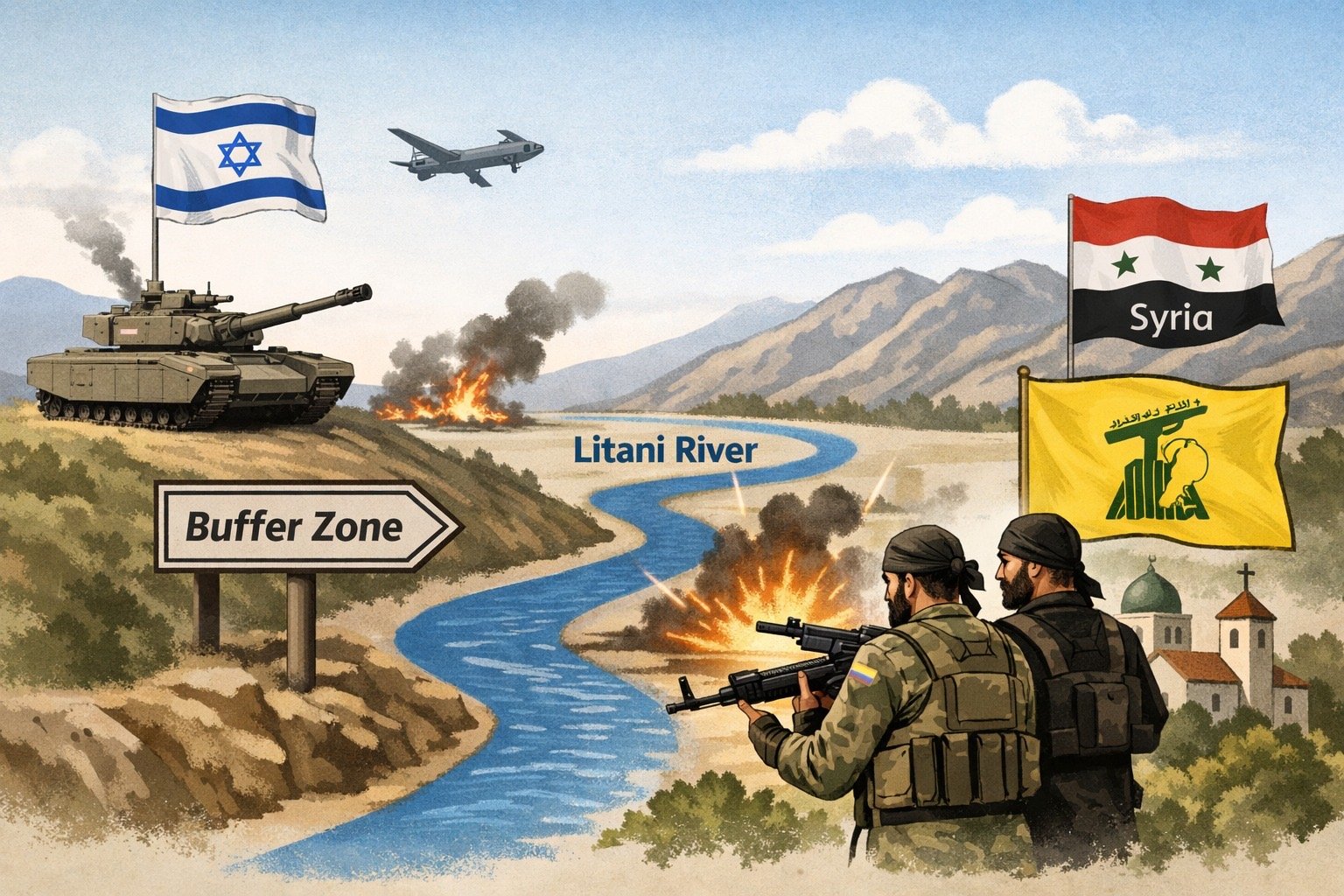
Hussein Mortada, Lebanese political analyst and director of the Sonar Media Center, argues that the Israeli objectives are part of a long-standing effort to establish a security buffer zone in southern Lebanon, extending toward the Litani River. This approach is presented as being justified by the need to secure northern settlements, but is also framed as part of a broader expansionist project involving incursions into Lebanese territory.
On the ground, he describes the situation as characterized by limited but recurring Israeli advances of a few kilometers, fluctuating frontlines, and daily clashes involving ambushes and attacks on armored units, with no clear or lasting territorial control established. According to this perspective, the buffer zone concept extends beyond a narrow border strip and reflects a deeper strategic aim to reshape the security and demographic reality of southern Lebanon.
Within this context, Hezbollah is described by Mortada as the central armed actor in southern Lebanon, alongside other affiliated political and resistance groups with cross-sectarian participation embedded in local society. He argues that resistance to any potential buffer zone or occupation is deeply rooted in the population and is expected to persist through multiple forms, including military, political, and popular means. The broader implications, in his view, are closely linked to Lebanon’s internal political tensions and regional dynamics, particularly developments in Syria and wider geopolitical rivalries, making any long-term stabilization under such a buffer zone highly contested and unstable.
Hussein Mortada
Alleged Israeli plan for a buffer zone up to the Litani River
There are naturally very significant developments on the ground. First of all, the Israeli objectives are clear and are not new; the creation of a buffer zone is not something born today, nor is it a product of recent events or this specific battle. We perceive, know, and possess a great deal of data confirming that there was, and still is, a major project that the Israelis are seeking to establish in the southern region to create a buffer zone. Of course, the stated goal is to bring the security of the settlements under control to prevent them from being targeted, but the project is much larger than that.
The project is related to an expansionist process carried out by the Israeli occupation entity. This is evident, firstly, from the map presented by the head of the occupation government, Netanyahu, when he spoke of the ‘Greater Israel’ project. Secondly, it is seen in the statements of numerous Israeli officials who claimed that the land of Palestine, or the areas they currently occupy, no longer have enough room for settlers and thatthey wish to expand the settlements.
Thirdly, it is clear that there are operations to seize Lebanese territory and attempts to expand in that region under the pretext of buffer zones and the protection of settlements and the like.
From a field perspective, there is a clear expansionist project; one can say there are multiple axes through which the Israelis are attempting to advance.
We have now completed the first month, and from a military standpoint, it is not possible to speak of achieving any ground objectives up to this moment. While it is true that the Israelis have made incursions, penetrating some areas, they have only reached a depth of between 3 to 4 kilometers.
Escalation and Resistance
Of course, it has reached about 5 kilometers sometimes, sometimes less, sometimes more, but this area is considered a shared area. Daily, there are clashes, daily there are ambushes, and daily there are targets against Israeli tanks. Therefore, I believe that the battle is now intensifying on the ground and may escalate more during the coming days
Actually, when the Israeli occupation speaks of a buffer zone, it is not just about a few kilometers. The project is much deeper, aiming to reach the Litani River.
This is part of a long-standing strategy to secure the northern borders by pushing the resistance forces back and dismantling their infrastructure in those areas. However, as we have seen in previous confrontations, these attempts often lead to a war of attrition that the occupation’s home front cannot sustain for long.”
Identity, Displacement, and the LitaniRegion
Through the current demographic composition, Israel seeks to create a rift by claiming that, for example, Hezbollah’s support base is from the Shia community, so they only target Shia villages, towns, and cities. First, the goal is to create a divide within Lebanese society by trying to say that they are not targeting anyone except those who target them.
However, we know this is very dangerous, as Israel does not distinguish between one region and another, one sect and another, or one neighborhood and another. Instead, it seeks to advance its project initially, and then, of course, all other areas and towns would come under Israeli mandate or occupation. Overall, all honorable people in the southern region reject the Israeli occupation and the establishment of a buffer zone.”
Armed Presence South of the LitaniRiver
It has become clear that Hezbollah is the most prominent entity, acting as a political party or as the spearhead of the resistance. Of course, there are other parties such as the Amal Movement, some national parties, the Syrian Social Nationalist Party, and the Lebanese Resistance Brigades. In this context, there are many individuals from almost every sect within these other parties who resist, fight, and have offered martyrs.
However, the most prominent at the top of the list is Hezbollah, as a resistance force currently fighting; it is the one practically present in the South and the one achieving heroic feats today against the Israeli occupation entity.”
Resistance Scenarios in Southern Lebanon
The core of the project, whether it is military, political, or popular resistance, is that we cannot accept things reaching the point where the Israeli imposes an equation through force. However, even if we assume for the sake of argument that it was able to create a buffer zone reaching the Litani River, it will not feel any stability or any security.
It already tried this when it occupied Lebanon in ’82 and reached Beirut, yet itpaid the price daily with the deaths of itssoldiers, and many operations were carried out daily against his positions. The resistance started as a popular resistance; thus, the core of the resistance is within the society, within the people. There are many methods that I believe the Lebanese can innovate, and they will not accept an occupation of their land.
Hezbollah Response to Israeli Ground Operations
The fighting doctrine stems, first and foremost, from a religious and ideological foundation. It is rooted in the nature of the conflict with the Israeli occupation entity and the rejection of the very existence of this entity. This is linked to the fact that the Palestinian people are oppressed and their land is occupied; therefore, we cannot recognize this entity from a religious standpoint.
As for the aspects related to military operations and rearmament, the resistance naturally possesses many capabilities. However, at the same time, the resistance was serious and sincere when it told the Lebanese state during a 15-month period: ‘Please, take over the responsibility of removing the Israeli occupation from certain points’.
Unfortunately, we know that a part of the Lebanese government is in favor of ending the resistance and supports the Israeli-American project. Consequently, the resistance felt a great deception; it handed over its weapons and moved from the area south of the Litani to a second stage they called ‘North of the Litani’.
This happened without any obligation on the Israeli side regarding any point or plan, as Israel did not implement anything from Resolution 1701. From this perspective, the resistance believes there is a strategic opportunity now, given the struggles the Israeli occupation entity is facing. It can use this opportunity to rearrange its military cards and re-impose equations.
Today’s battle is about imposing equations; the Israeli must be deterred so that they do not think once again about invading or attacking Lebanon. While it is true that there are martyrs, casualties, and destruction, we did not choose this war; it was imposed on us, and we must pay with everything we possess to expel this occupier.
As for the issue of destroying bridges and imposing a buffer zone in this specific geography, this is not the first time. In 1982, before 2000, and in 2006, Israel also destroyed bridges and tried to establish a buffer zone but failed.
The policy of destroying bridges does not work against a people who refuse to be occupied and does not achieve security for the Israeli occupation entity.
Internal divisions in Lebanon over the Southern border issue
To be honest, we are now living through the worst phases Lebanon has ever experienced on all levels. Unfortunately, there is a political faction that is part of the Israeli-American project. This is the worst period for Lebanon in terms of promoting normalization and so-called ‘peace’ with the Israeli occupation entity. This has caused a kind of internal division in Lebanon.
We have begun to notice voices promoting the idea of normalization and peace with the Israeli entity. However, as a general principle, I do not believe any Lebanese person accepts a buffer zone or the occupation of any part of Lebanese land.
Nevertheless, those calling for normalization—whether in media, politics, or elsewhere—are a minority with well-known affiliations, policies, and orientations.
Israel, Syria, and the wider buffer zone debate
“The implementation of this project is very dangerous from a strategic perspective, as it has repercussions beyond just Southern Lebanon. We know that the Israeli project is now expanding towards Syria; after the fall of the regime in Syria, many things changed. Israel now occupies a large part of Syrian territory, and the entire Syrian south is under the control of the Israeli occupation entity. Israel has reached the most important strategic areas in terms of Mount Hermon. If Israel establishes a buffer zone in Lebanon, it seeks to connect it from the Shebaa Farms to the occupied Syrian Golan and the Syrian south.
This region would become a continuous area controlled by the Israeli occupation entity, where they might establish a Druze state or another entity. This is a major expansionist project, which gives the Israeli occupation entity an incentive to continue occupying Arab lands. We know that Israel pays no heed to international resolutions; there are many resolutions it has not implemented, including Resolution 425 issued after the 1982 invasion. Israel did not implement it out of respect for the law, but because there was a resistance that forced the occupation to withdraw. It did not comply with international decisions.
Today, we must look at the bigger picture; Lebanon has become part of a changing regional map. Field and political developments in Lebanon cannot be separated from what is happening in the region or the war imposed on the Islamic Republic of Iran. Today, Iran has made the Lebanese file part of any negotiation or settlement in the region. This clearly shows that whoever wins this battle will determine the nature of the map and future paths. If Iran wins its battle against the Americans—and God willing, it will—and Lebanon is part of this settlement, things will change completely. Israel will then have to withdraw, and there must be settlements within Lebanon.
Risk of Regional Escalation
Today, we must speak from a broader perspective; in summary, Lebanon has now become part of a changing regional map. Field and political developments in Lebanon cannot be separated from what is happening in the region or the war imposed on the Islamic Republic of Iran. Today, Iran has made the Lebanese file part of any negotiation or settlement in the region. This clearly shows that whoever wins this battle will determine the nature of the map, their priorities, and future paths.
If Iran wins its battle against the Americans—and God willing, it will—and Lebanon is part of this settlement, things will change completely. Israel will then have to withdraw, and there must be settlements within Lebanon. Victory practically reflects positively on the resistance, its environment, and the political parties that support it.
If it were the opposite, the nature and map of the region would change because we know the Israeli expansionist project and the threats it issues not only towards Iranian leaders or resistance leaders. We know the danger towards Turkey and some Arab countries; this is an expansionist project. I believe we can no longer focus on the Lebanese file in isolation from other developments and the results of the broader battle, especially since Yemen has also entered this battle in the past few hours. We are facing major developments and a new map; whoever wins determines the nature of this stage.