

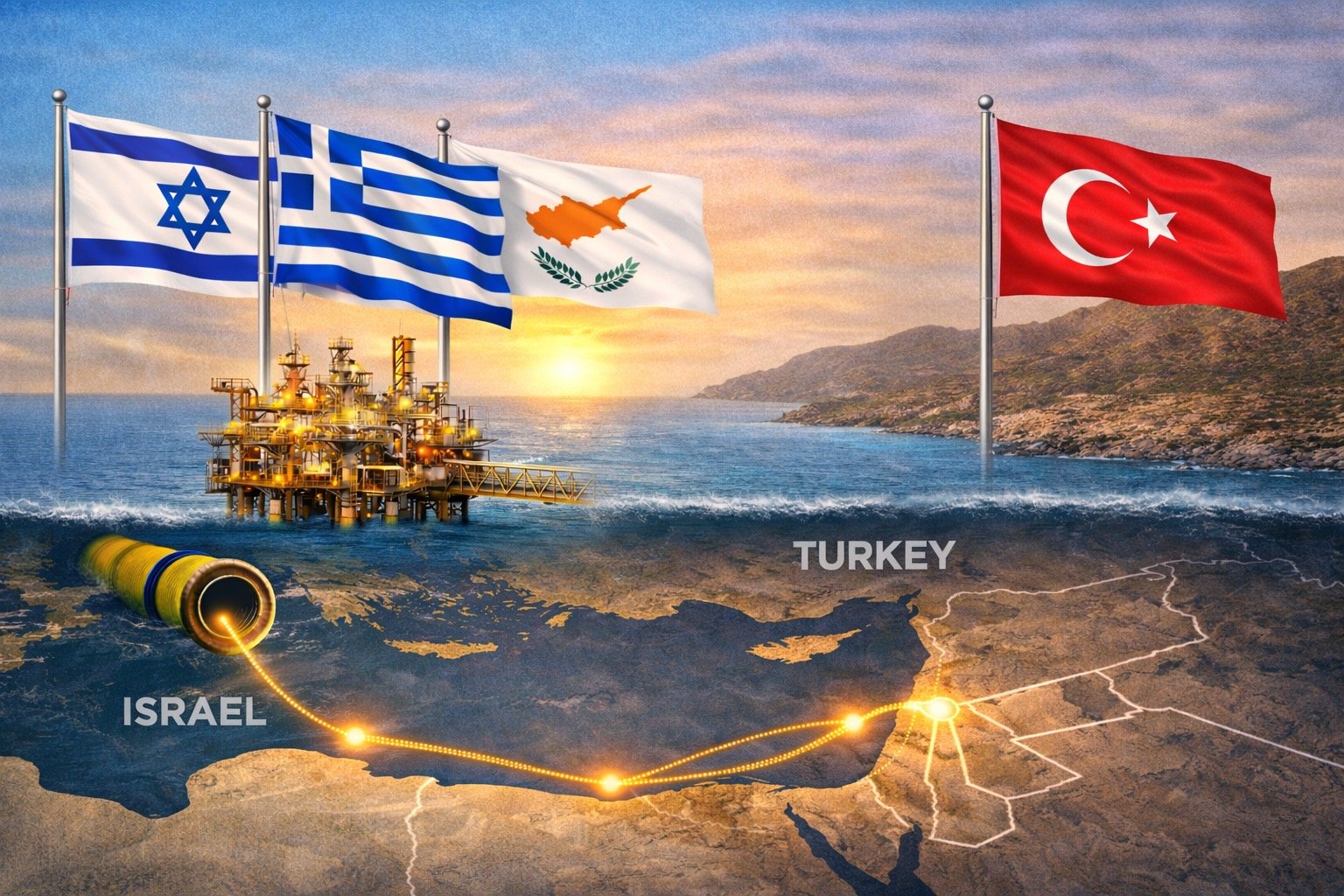
Written by Michalis Kontos—Associate Professor, Associate Head, and Program Coordinator in the Department of Politics and Governance at the School of Law, University of Nicosia—this analysis examines the emergence of a strategic axis in the Eastern Mediterranean centered on cooperation between Israel, Greece, and Cyprus. Kontos situates this trilateral alignment within a broader framework that combines energy security, geopolitical balancing, and normative alignment with the European-Western sphere. At its core, the partnership is driven by shared interests in natural gas development and export, regional stability, and the containment of competing maritime ambitions, particularly those associated with Turkey.
The article argues that this evolving axis extends beyond economic cooperation into the realms of security coordination, deterrence, and long-term strategic positioning. Through joint military exercises, infrastructure projects such as the EastMed pipeline, and institutional linkages to the European Union, the Israel–Greece–Cyprus partnership is increasingly shaping the geopolitical landscape of the region. At the same time, Kontoshighlights both the opportunities and risks inherent in this alignment, including the potential for escalation with rival actors, the fragility of energy infrastructure, and the broader implications for regional stability and power dynamics in the Eastern Mediterranean.
The common strategic foundation of Israel’s foreign policy and its energy agreements with Greece and Cyprus rests on the creation of a stable Eastern Mediterranean axis that combines energy, security, and geopolitical interests. This cooperation is based on the development and export of natural gas to Europe while bypassing Turkey and Russia, curbing Turkish hegemonic ambitions in the maritime domain, and strengthening status-quo states that operate in accordance with international law. At the same time, the relationship has deepened through military exercises and security cooperation and is anchored in a normative perception of partnership among Eastern Mediterranean democracies connected to the broader European-Western sphere.
Economic Cooperation and the Emerging Security Dimension
The cooperation frameworks established in the Cyprus–Greece–Israel triangle are not limited to the economic sphere alone but also carry a clear—though informal—security and deterrence dimension. Beyond energy and infrastructure projects, the three states have developed joint military exercises, air and naval cooperation, and strategic coordination on regional security issues, particularly in the Eastern Mediterranean. The very existence of an ongoing cooperative framework, based on shared interests and coordinated military presence, conveys a deterrent message to rival regional actors, most notably Turkey, and strengthens regional stability even in the absence of a formal security alliance.
Cyprus as a Strategic Anchor
Cyprus is not becoming an independent leading actor in the classical sense of a regional power, at least for the time being (though the future is always uncertain). However, it is effectively leveraging its geopolitical position to enhance its regional weight. Through cooperation with Israel and Greece, and by relying on its membership in the European Union, Cyprus deliberately aligns itself with the strategies of actors larger than itself, yet it does so by choice rather than subordination. In this way, it functions as a mediating and anchoring actor that links regional interests with European frameworks, strengthens its diplomatic and security standing, and increases its influence in the Eastern Mediterranean despite its limited power capabilities.
Strategic Benefits for Israel and Greece
Greece and Israel derive tangible benefits from this cooperation in the fields of energy, security, and regional diplomacy. Israel gains a strategic route for exporting natural gas to European markets, strengthens its position as a legitimate actor in the Mediterranean arena, and deepens security cooperation with states that are members of the European Union and NATO. Greece benefits by reinforcing its role as a regional energy hub, enhancing its geopolitical standing in the Eastern Mediterranean, and expanding military cooperation that helps balance Turkish pressure.
Cyprus plays a central role as a geographic, legal, and institutional anchor. It serves as a connecting link between Israel and Greece, provides European legitimacy through its European Union membership, and enables the institutionalization of joint energy and security projects within a stable regional framework.
Opportunities and Risks for the Regional Balance
If current trends continue, the position of Israel, Greece, and Cyprus in the Eastern Mediterranean will present significant opportunities alongside notable risks in the medium to long term. On the positive side, further deepening of cooperation may consolidate a stable regional axis combining security, energy, and ties with Europe. It may also strengthen European energy independence and enhance the three states’ status as central actors in the Mediterranean arena.
At the same time, there are risks of geopolitical escalation with Turkey and other regional actors, the vulnerability of offshore energy infrastructure to military or hybrid threats, and overdependence on long-term projects exposed to shifts in global energy markets and the transition to renewable energy. In addition, increasing politicization of these partnerships could turn the axis into a source of friction rather than a stabilizing factor if not managed with diplomatic caution.
From a broader regional perspective, cooperation among four Eastern Mediterranean states could have benefited the entire region and contributed to long-term stability. However, Turkey’s aggressive foreign policy, its preference for heavy investment in arms production and militarization rather than investment in its citizens and in addressing its faltering economy, makes it difficult for it to integrate into such a cooperative regional framework. Instead, Turkey appears to favor deepening relations with countries such as Iran rather than building trust and cooperation with its other Eastern Mediterranean neighbors.
Egypt’s Position and Lebanon’s Constraints
Egypt may deepen its involvement in regional cooperation frameworks in the Eastern Mediterranean, but it is likely to do so cautiously and on the basis of narrow interest-based calculations rather than as part of a formal and openly declared alliance with Israel, Greece, and Cyprus.
Public discourse in Egypt regarding the war in Gaza is extremely harsh, and the Egyptian regime employs critical rhetoric toward Israel. This rhetoric is driven in part by the scale of destruction in Gaza and by the declared fear of Palestinian displacement into Sinai, which Cairo defines as a national and security red line. At the same time, there is also a degree of Israeli suspicion toward Egypt, particularly regarding its role at the Rafah border crossing, the Philadelphi Corridor, and Cairo’s ongoing relations with Hamas.
It is important to distinguish between public rhetoric and the strategic interests of the Egyptian regime. Although Egypt maintains contacts with Hamas, grants it a certain degree of legitimacy in the Arab arena, and serves as a central mediator vis-à-vis the organization, Hamas is also perceived by the leadership in Cairo as a potential security threat and as an offshoot of the Muslim Brotherhood—an explicit ideological and regime-level adversary of the al-Sisi government.
From a strictly interest-based perspective, Egypt does not fundamentally oppose the weakening of Hamas and may even benefit from the destruction of its military and governing capabilities, provided that this does not entail direct harm to Egypt’s security, sovereignty, or internal stability.
Lebanon, by contrast, is currently far removed from any realistic possibility of joining a regional cooperation framework that includes Israel. The deep economic and political crisis, the collapse of state institutions, and the dominance of Hezbollah—a military-political actor largely subordinate to Iran—effectively eliminate Lebanon’s ability to act as an independent sovereign player in the regional arena.
Even if potential energy-related interests exist, the ongoing confrontation with Israel and the subordination of strategic decision-making to non-state actors render the prospect of Lebanon’s participation in such a regional cooperative framework highly unlikely in the foreseeable future.
The Strategic Importance of the EastMed Project
The cooperation between Israel, Greece, and Cyprus provides the EastMed project with a decisive strategic contribution that goes beyond the technical aspect of laying a gas pipeline.First and foremost, it creates a coordinated political and legal framework among three states that share a clear interest in exporting Eastern Mediterranean gas to Europe, thereby reducing regulatory uncertainty and strengthening investor confidence.
At the same time, this cooperation adds a security and deterrence dimension to the project through maritime coordination, joint military exercises, and a coordinated military presence. These measures help protect offshore energy infrastructure from state and non-state threats.
In addition, the Israel–Greece–Cyprus axis anchors the EastMed project within a broader European context by establishing a direct link to the European Union and its member states, presenting the project as part of Europe’s energy security strategy. Finally, the existence of a coordinated regional partnership enhances the project’s resilience to external geopolitical pressures—most notably Turkish opposition—and enables it to be advanced not merely as an economic venture but as a long-term political and strategic instrument.
Turkey’s Policies and the Formation of the Trilateral Alignment
There is a direct and substantial link between the strategic cooperation among Israel, Greece, and Cyprus and Turkey’s aggressive policies in the Eastern Mediterranean, particularly toward these three states.
It should be emphasized that if it were not for Turkey’s threatening rhetoric and concrete actions, this cooperation would not be perceived as a significant regional threat. The trilateral alignment is not an offensive initiative but rather a response to an assertive and destabilizing Turkish foreign policy.
From Israel’s perspective, one of the most troubling scenarios is the possibility that Turkey may seek to introduce a military or non-regular security presence in the Gaza Strip, whether within the framework of an international force or through indirect channels. Such a development could restrict the Israel Defense Forces’ freedom of action and, in practice, assist Hamas by facilitating the smuggling of weapons, transferring operational know-how, or creating a political and security umbrella that would enable the organization to rebuild itself after the fighting. This concern is reinforced by Ankara’s consistent and public support for Hamas.
In addition, there is growing concern in Israel regarding the expansion of Turkey’s military presence in Syria, including the deployment of intelligence assets, radar systems, and air-defense capabilities, as well as the possibility of systematic monitoring of Israeli military activity in the northern arena. Such moves could significantly constrain Israel’s operational freedom, affect the regional balance of deterrence, and increase the risk of direct or indirect friction between the two countries. In this context, cooperation with Greece and Cyprus—encompassing joint military exercises, air and naval coordination, and ongoing strategic dialogue—is intended to create a deterrent counterweight vis-à-vis Turkey without escalating into a direct military confrontation.
For Greece and Cyprus, the partnership provides enhanced security and intelligence depth in the face of sustained Turkish pressure in maritime and territorial disputes. For Israel, it serves as a strategic anchor that enables the creation of a balanced and indirect deterrent vis-à-vis Ankara.
Accordingly, the trilateral partnership is not the source of the threat but rather its product. It emerged against the backdrop of Turkey’s verbal and practical threats toward Israel, Greece, and Cyprus and is designed to curb Turkish interventionist and hegemonic ambitions, preserve freedom of military action, and safeguard relative stability in the Eastern Mediterranean.
Israel’s Perspective on the Future of the Druze
Israel does not actively promote the establishment of an independent Druze state in the Levant, but it also does not reject the idea in principle if such a development were to occur through broad agreement and within a legitimate state framework—first and foremost if it were acceptable to the Syrian government and other relevant regional actors.From Israel’s perspective, the question is not ideological or national in nature but primarily one of security and regional stability.
The Druze are viewed by Israel as a minority with a distinct identity deeply rooted within existing states—Israel, Syria, and Lebanon—rather than as a clearly defined national movement seeking sovereignty. Over the years, Israel’s policy has emphasized integration, protection, and the preservation of the Druze way of life within established state frameworks.
At the same time, under changing regional conditions, Israel evaluates possible scenarios mainly through the lens of stability: whether such a development would reduce violence, protect civilian populations, and prevent the penetration of hostile actors.
At the regional level, Israel is aware that the creation of a new state entity based on sectarian identity could be fragile and expose the Druze to pressure from stronger actors such as Iran, Hezbollah, various militias, or other regional forces. Therefore, even if the idea of an autonomous Druze framework were to emerge in the future, Israel would assess it primarily in terms of its ability to provide real security rather than allowing the Druze to become targets of intervention or political exploitation.
It is important to emphasize that Israel has a deep and long-standing commitment to the Druze, both as its own citizens and as neighboring communities in the Levant. This commitment is moral, civic, and security-related. Israel sees itself as obligated to act—through diplomatic, humanitarian, and, if necessary, security means—to protect the Druze from aggression, persecution, or violence by any actor, whether state or non-state.
To conclude, Israel’s position is pragmatic and cautious. It does not seek the establishment of a Druze state but does not rule out future scenarios if they meet clear criteria of legitimacy, regional consent, and above all stability and security. Above all, the protection and well-being of the Druze remain a central guiding principle for Israel, regardless of the state framework in which they live.