

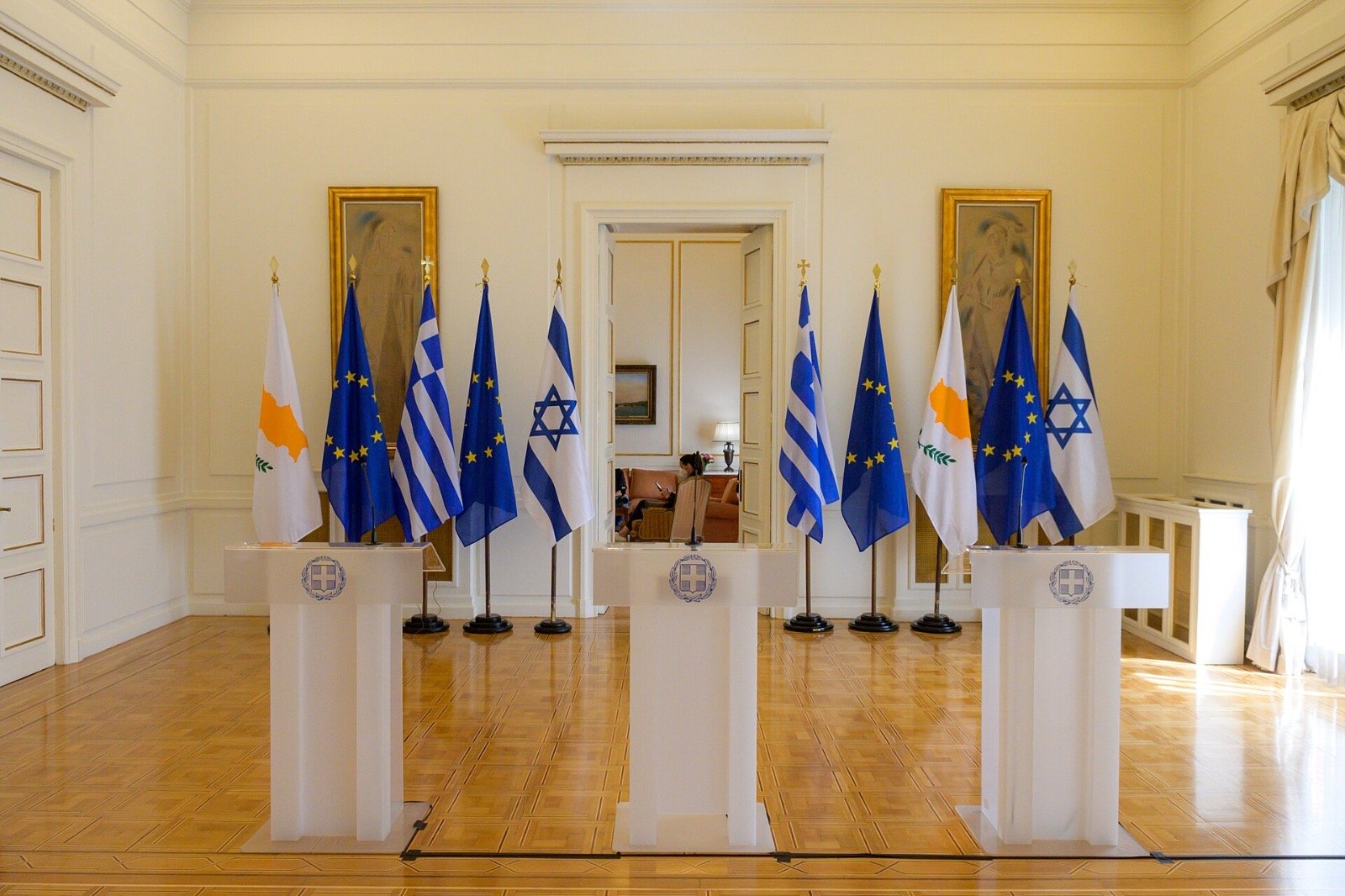
The cooperation between Israel, Greece, and Cyprus has developed mainly over the past 10–15 years, driven by shared energy interests in the Eastern Mediterranean and common political concerns. Natural gas discoveries and export routes have played a central role in bringing the three countries closer, alongside their shared tensions with Turkey. The relationship is largely political in nature, aimed at demonstrating alignment and mutual support in a region marked by rivalry, rather than forming a strong military alliance.
This cooperation reflects economic interdependence and political signaling rather than binding security commitments. While it strengthens the sense of solidarity among the three countries, it does not imply that they would fight for one another. Regional actors such as Egypt and Lebanon are expected to remain cautious and mostly outside this structure, while external powers like the United States and the EU are not actively encouraging escalation. Overall, the arrangement represents a pragmatic alignment shaped by energy politics and regional competition.
Prof. Eyal Zisser is the Vice Rector of Tel Aviv University and the holder of The Yonaand Dina Ettinger Chair in Contemporary History of the Middle East. He was the Dean of the Faculty of Humanities 2010-2015, the Director of the Moshe Dayan Center for Middle Eastern and African Studies 2007-2010 and the Head of the Department of Middle Eastern and African History.
First of all, we are not speaking about something that has historical depth. Because relations between the three countries became more close only during the last 10-15 years. Until then, these were very cold relations with no meaning. And I think energy was one of the issues that the gas that pushed the relations forward because there was common economic interest. And then came also the military cooperation, but you know, Greece and Cyprus don’t have any strong armies with strong capabilities. They can provide Israel with places to train or deploy aircraft. But the important thing here is the symbolic, the political issue. I mean, they all feel threatened and as a result, they deepen their relations. But by doing so, they send a political message because they are not strong and it’s mainly something political combined with the economic one.
Energy resources as the main catalyst of regional alignment
I think that when you sign an agreement and cooperate, if we speak about strong armies and the possibility of war, it has a military meaning. Here, nobody expects a war. It’s a political tension in the Mediterranean. Nobody expects war. So, Greece and Cyprus are not very strong. So, it’s not only economic, it’s political. Because we are speaking about rivalry, we are speaking about political tension. So, the idea behind this alliance is to send a political message, because it’s quite clear that this has no military meaning and nobody expects anyone to fight on behalf of the other.
The US and the EU do not want a crisis in the Eastern Mediterranean
I think that the main issue is what makes Cyprus important is the economy. And the possibility, if you want to export gas to Europe, you can do it either through Turkey, but Turkey is not interested, so through Cyprus. So, Cyprus is a key here, is important here for this economic reason. And as I said before, all three countries have political problems with Turkey and they want to send a message. But I don’t think that anyone outside the region is interested in increasing the tension. So, the Americans and the Europeans are not interested in increasing the tension. I guess they say, okay, as a political move, do what you want. But there is nothing more than political here.
Greece and Cyprus want to feel stronger by bringing Israel to their side
The economy issue is, you know, through Greece you get to Europe. That’s one thing when we speak about the gas. And then the feeling that you are not alone.You have many problems and difficulties. This is some sort of an alliance. So it’s more political because nobody will use it and nobody is going to fight, but it’s more something political. That’s what they gain. They have tensions with neighbors, okay, so they feel politically stronger.
Israel will not fight for Cyprus and Greece
If there can be clashes, there can be incidents, increasing tension, so, this will push the three countries to cooperate more on these fields, push them together. That’s what will, I guess, happen. Everybody knows that nobody will fight for anybody, even if there is an alliance. So, nobody will tell to, will say to himself, because there is an alliance.
I don’t think Egypt and Lebanon will join the Israel–Cyprus–Greece axis
When it comes to the economy, yes, they are part of it. When it comes to the economy, and the economy is the first issue, and many of the conflicts can happen because of the economy. If Egypt says, this is my water and I want to exploit it and I want to find gas, so it’s an economic issue, but it can lead to tension. But I think that both Lebanon and Egypt will stay on the sidelines. They do not want to get involved directly in such an alliance where the issues are so complicated.
Eastern Mediterranean gas projects and European energy strategy
I think this is part of the issue, but you need money, you need American insurance. It’s very, very much in the beginning, and if the demand in Europe will increase, so it will become economically, it’s a question whether, you know, it can be implemented. I don’t know because Israel has just signed a huge deal with Egypt, so most of the gas will be exported to Egypt, so I don’t know if Israel has enough gas to export to Europe, but maybe Lebanon, maybe Syria, maybe Cyprus.
Impact of external energy companies and regional competition
No, I think not because the French companies are working in Lebanon and this is very initial step. Maybe in the coming future, if they find gas and they start exploiting it, they will join. But right now it’s only theoretical.
Turkey’s policies have brought the three countries together
Yes, for sure. I mean, because Turkey is very much assertive toward these countries, it pushes these countries to do things they didn’t dare or didn’t think about before. But because Turkey is playing it very hard, it pushes those countries to work together.
Some Israelis support a Druze state
I don’t know if it’s a viable option. I mean, because the Druze never wanted a state. They are not a nation. This is a community that lives in Syria for so many years. So, I doubt very much whether it’s viable. Yes, but there are Israelis who play with this idea that Syria will be split into smallcountries, Al-Alawite, Yes, there are clearly some Israelis that support it. So, it’s not an official policy, but yes, there are Israelis who support it.