

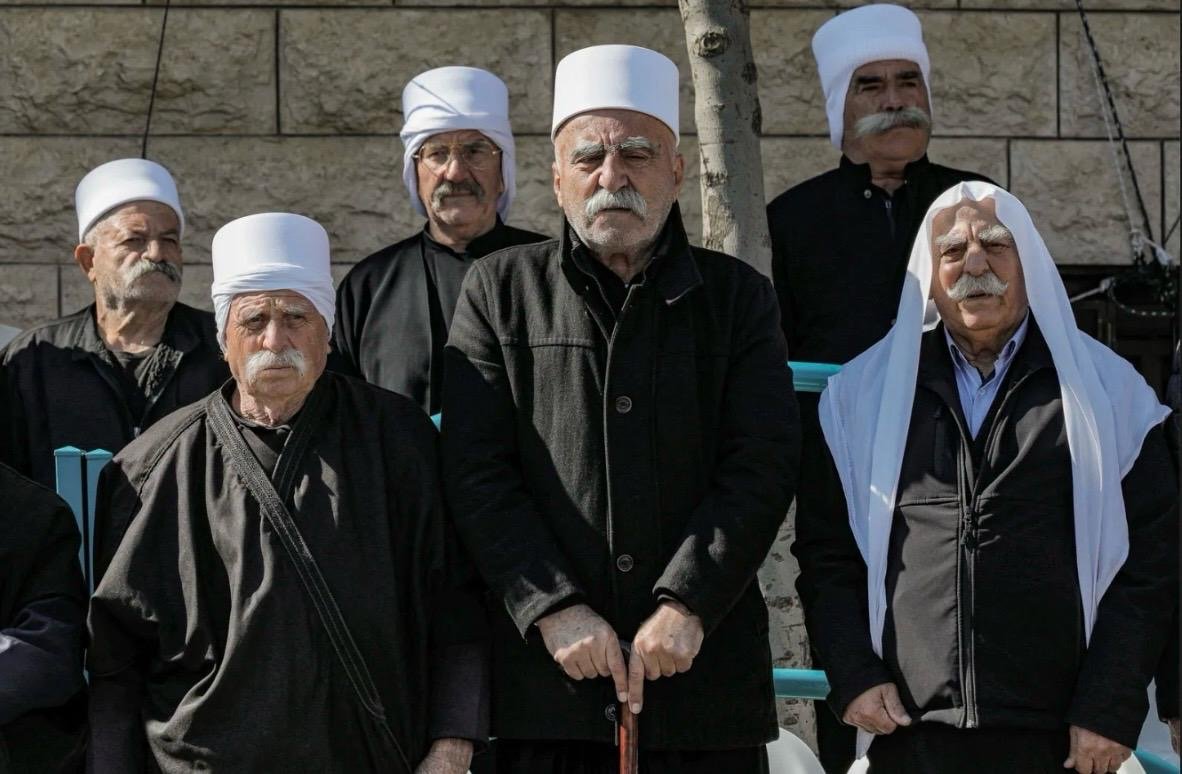
The situation in As-Suwayda reflects a complex balance between strong attachment to Syrian state identity and deep dissatisfaction with current governance practices. The Druze community emphasizes its historical and political integration within Syria, rejecting any narratives of separation, while at the same time calling for inclusive governance, genuine dialogue, and equal citizenship. The clashes that took place in the first half of last year, particularly with Bedouin groups, strained local dynamics, yet there remains an underlying belief that community-level dialogue and reconciliation are still possible despite the tensions.
Regional dynamics further complicate the picture, with external actors perceived largely through the lens of their own strategic interests. Claims of Iranian or Russian influence are dismissed, while Israel’s actions are seen as primarily security-driven rather than protective. Meanwhile, countries such as Turkey are viewed as maintaining a cautious, interest-based stance without direct involvement in southern Syria. Local armed structures are described as temporary responses to insecurity rather than long-term alternatives to the state, and displacement is portrayed as largely forced rather than voluntary. These perspectives are articulated by Ata Ferhat, a Syrian journalist closely following developments in the region.
Ata Ferhat is a Syrian journalist who graduated from the Faculty of Arts, Department of Journalism at Damascus University in 2000 and later obtained a master’s degree in International Relations from the University of Leeds. He has worked as a correspondent since 2010 for Syrian state television and appeared as an analyst on several Arab satellite channels, and currently works as an independent journalist.
Ata Ferhat
Druze position during the clashes in As-Suwayda
As-Suwayda is an integral part of the Syrian Arab Republic, and its people have been Syrians for thousands of years. Therefore, any attempt to exploit their Syrian identity or separate them will fail because they are an inseparable part of Syria and have never sought such a project, but rather worked to overthrow it repeatedly.
After the May agreement between the Damascus government represented by its governor Mustafa Bakour and the notables of As-Suwayda, including Sheikh Hikmat al-Hajri, the agreement began to be implemented by the people of As-Suwayda by bringing the state into the province and affiliating to the public security and police. However, the party that violated this agreement was the state itself when it attacked As-Suwayda, even firing at members of the public security who were from the province without notifying them of the operation or the attack.
As-Suwayda has always affirmed that its direction is Damascus and will not be otherwise. The dialogue was never rejected, but what is required from the government of “al-Shar” (the legitimacy or authority) is to abandon extremism and religion and treat Syrians as one people, not by sects. Syria cannot be governed by the same policies applied to Idlib—there is a difference, and what worked in Idlib is not applicable to Syria. Hope is not lost, and I believe dialogue will return, and an agreement will be reached.
External influence: Israel, Iran, and Russia
Regarding influence of some countries.There is no Iranian or Russian influence over As-Suwayda. I think these allegations are excuses used by the Damascus government and others to justify their attack on As-Suwayda and to claim external forces are manipulating them. As for Israel, it only acted under pressure from the Druze community in Israel, and its intervention was not meant to change the course of the battle but to calm the tense situation inside Israel due to the significant Druze mobilization there. Therefore, the relationship of the people of As-Suwayda is not with the Israeli state but with their Druze brethren who stood by them in this crisis.
Druze wants international protection to prevent their extermination
There is undoubtedly a whole generation that grew up during the long war, which has affected them psychologically, socially, economically, and politically. However, to this day, I have not seen protests in As-Suwayda demanding Israeli occupation or intervention or calling on any other country. Their demand is a natural right during crises for any ethnic or sectarian group: international protection to prevent their extermination.
If the people of As-Suwayda and the youth generation rejected the Damascus government, they could have held demonstrations supporting the West and Israel. Students from As-Suwayda attend state universities, including in Homs, Aleppo, Latakia, and Damascus, despite the dangerous attacks on them.
Still, the new generation has many criticisms of the government of al-Shar, which is entirely run by a small group from Hay’at Tahrir al-Sham. Where is the law that has been abandoned? Where is the constitution? Where is the national dialogue, which was a farce? How is the People’s Council formed? Dozens of questions show that what is applied on the ground is wrong, and al-Shar did not transition to become a dictator over the Syrian people.
Integration, autonomy, or external support
The Druze and As-Suwayda are part of the Syrian Arab Republic and cannot be outside it. Countries can plan and officials can say whatever they want, but on the ground, the people of As-Suwayda do not want to abandon Damascus.
Those who created Syria’s independence and sparked the first flame against the French over 100 years ago cannot be outside the state. The history of As-Suwayda is well known, and anyone who seeks to divide it will fail along with their schemes.
However, the Damascus government must understand that As-Suwayda cannot be subdued by force; only dialogue and agreement can achieve that.
Role of the As-Suwayda Military Council
Practically, after the May agreement and before the events in As-Suwayda, more than 2,500 people from As-Suwayda were serving in the Ministry of Defense and inside the military institution. They have never rejected the state, but the state rejected them; this is the truth, which undermined and violated agreements, forcing them to remain outside for unknown goals.
The Military Council was established to protect As-Suwayda, and when there is a real state and a real army representing Syrians, there will be no need for such a council or weapons because there will be someone to protect all citizens.
Israel’s strategy and its approach to the Druze
The tragicomic fact is that the attack on the General Staff in Damascus was announced to the Damascus government fifteen minutes beforehand, meaning it was coordinated with it. Israel seems to act in coordination with Damascus government. Despite the strikes on Damascus and As-Suwayda, meetings between officials continued as if nothing happened.
Therefore, the Israeli side apparently coordinates behind the scenes with the Damascus government, and the strikes are carried out with its knowledge.
The “Demilitarized Zone” proposal and its implications
The demilitarized zone is not for protecting the Druze but for protecting Israel’s borders. Israel does not want heavy weapons or extremist religious groups near its borders and wants to remove heavy weapons from southern Syria in Daraa and Quneitra. This agreement cannot be justified as protecting the Druze or others; it is merely to remove Israeli fears of a repeat of the October 7 events and massacres against the Israeli people.
Turkey’s role and the Druze perspective
Ankara, like other countries, works in its own interest and has natural interests with the Damascus government. It did not intervene in the As-Suwayda issue because southern Syria seems outside its concerns, and it does not want any friction with Israel that might create future tensions.
Therefore, it left the file to the Damascus government and supported it within statements that it will not allow Syria’s division, which it knows well the people of As-Suwayda would oppose.
Displacement and migration after the clashes
They did not emigrate voluntarily but were forced to leave their homes due to war and fierce attacks on them. Today, they have started returning to their villages and homes that were burned and destroyed by the Bedouins and the lack of Syrian public security.
Regarding movement toward Rif Damascus, I have not noticed any because the roads to As-Suwayda are still cut off and besieged. If anyone leaves, they are originally from Sahna and Jarmana and other areas.
As for going abroad, I do not believe anyone left, and I have no information about that.
The Druze diaspora and political representation
The Druze in Israel have parliamentary representation, as do the Druze in Jordan, Lebanon, and previously Syria. However, currently, in Syria, there is a minister who is only a figurehead representing the sect but practically does not represent anything.